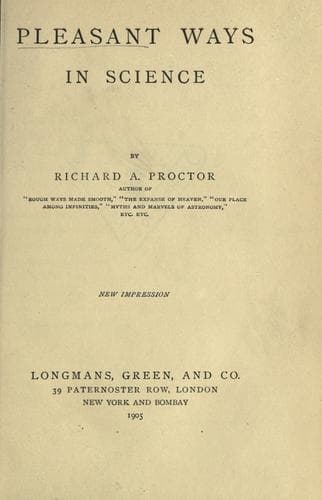
Pleasant Ways in ScienceProctor, Richard A. (Richard Anthony)
Science
Pleasant Ways in Science
Proctor, Richard A. (Richard Anthony)
Science
A planet could not very well come into final conflict with its sun at
one fell swoop. It would gradually draw nearer and nearer, not by the
narrowing of its path, but by the change of the path’s shape. The path
would, in fact, become more and more eccentric; until at length, at its
point of nearest approach, the planet would graze its primary, exciting
an intense heat where it struck, but escaping actual destruction that
time. The planet would make another circuit, and again graze the sun,
at or near the same part of the planet’s path. For several circuits
this would continue, the grazes not becoming more and more effective
each time, but rather less. The interval between them, however, would
grow continually less and less; at last the time would come when
the planet’s path would be reduced to the circular form, its globe
touching the sun’s all the way round, and then the planet would very
quickly be reduced to vapour and partly burned up, its substance being
absorbed by its sun. But all successive grazes would be indicated to
us by accessions of lustre, the period between each seeming outburst
being only a few months at first, and gradually becoming less and less
(during a long course of years, perhaps even of centuries) until the
planet was finally destroyed. Nothing of this sort has happened in the
case of any so-called new star. As for the rush of a star through a
nebulous mass, that is a theory which would scarcely be entertained by
any one acquainted with the enormous distances separating the gaseous
star-clouds properly called nebulæ. There may be small clouds of the
same sort scattered much more freely through space; but we have not a
particle of evidence that this is actually the case. All we certainly
_know_ about star-cloudlets suggests that the distances separating them
from each other are comparable with those which separate star from
star, in which case the idea of a star coming into collision with a
star-cloudlet, and still more the idea of this occurring several times
in a century, is wild in the extreme.
Public-domain text, read in full here on John Shaqi.
Reviews
Reviews
No reviews yet
Be the first to share your thoughts on this work.
Elsewhere in the archive
Join the Discussion
Join the discussion
Sign in to leave a comment or review.
Sign InorCreate an account