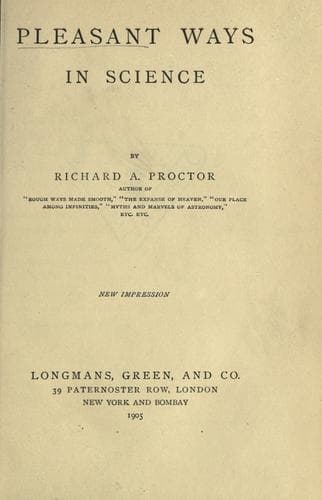
Pleasant Ways in ScienceProctor, Richard A. (Richard Anthony)
Science
Pleasant Ways in Science
Proctor, Richard A. (Richard Anthony)
Science
“In many places,” says Sir J. Herschel, “the telegraph wires struck
work. At Washington and Philadelphia, the electric signalmen received
severe electric shocks. At a station in Norway, the telegraphic
apparatus was set fire to, and at Boston, in North America, a flame of
fire followed the pen of Bain’s electric telegraph, which writes down
the message upon chemically prepared paper.”
We see, then, that most certainly the sun can be locally excited to
increased emission of light and heat, which nevertheless may last but
for a very short time; and we have good reason for believing that the
actual cause of the sudden change in his condition was the downfall
of meteoric matter upon a portion of his surface. We may well believe
that, whatever the cause may have been, it was one which might in the
case of other suns, or even in our sun’s own case, affect a much larger
portion of the photosphere. If this happened there would be just
such an accession of splendour as we recognize in the case of the new
stars. And as the small local accession of brilliancy lasted only a few
minutes, we can well believe that an increase of surface brilliancy
affecting a much larger portion of the photosphere, or even the entire
photosphere, might last but for a few days or weeks.
All that can be said in the way of negative evidence, so far as our
own sun is concerned, is that we have no reason for believing that
our sun has, at any time within many thousands of years, been excited
to emit even for a few hours a much greater amount of light and heat
than usual; so that it has afforded no direct evidence in favour of
the belief that other suns may be roused to many times their normal
splendour, and yet very quickly resume that usual lustre. But we know
that our sun, whether because of his situation in space, or of his
position in time (that is, the stage of solar development to which he
has at present attained), belongs to the class of stars which shine
with steady lustre. He does not vary like Betelgeux, for example, which
is not only a sun like him as to general character, but notably a
larger and more massive orb. Still less is he like Mira, the Wonderful
Star; or like that more wonderful variable star, Eta Argûs, which at
one time shines with a lustre nearly equalling that of the bright
Sirius, and anon fades away almost into utter invisibility. He _is_ a
variable sun, for we cannot suppose that the waxing and waning of the
sun-spot period leaves his lustre, as a whole, altogether unaffected.
But his variation is so slight that, with all ordinary methods of
photometric measurement by observers stationed on worlds which circle
around other suns, it must be absolutely undiscernible. We do not,
however, reject Betelgeux, or Mira, or even Eta Argûs, from among stars
because they vary in lustre. We recognize the fact that, as in glory,
so in condition and in changes of condition, one star differeth from
another.
Public-domain text, read in full here on John Shaqi.
Reviews
Reviews
No reviews yet
Be the first to share your thoughts on this work.
Elsewhere in the archive
Join the Discussion
Join the discussion
Sign in to leave a comment or review.
Sign InorCreate an account