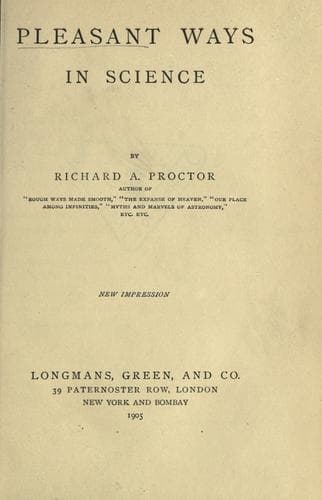
Pleasant Ways in ScienceProctor, Richard A. (Richard Anthony)
Science
Pleasant Ways in Science
Proctor, Richard A. (Richard Anthony)
Science
Doubtless there are excellent reasons for rejecting the theory that a
massive body like a planet, or a nebulous mass like those which are
found among the star-depths (the least of which would exceed many
times in volume a sphere filling the entire space of the orbit of
Neptune), fell on some remote sun in the Northern Crown. But there are
no sufficient reasons for rejecting or even doubting the theory that
a comet, bearing in its train a flight of many millions of meteoric
masses, falling directly upon such a sun, might cause it to shine
with many times its ordinary lustre, but only for a short time, a few
months or weeks, or a few days, or even hours. In the article entitled
“Suns in Flames,” in my “Myths and Marvels of Astronomy,” before the
startling evidence recently obtained from the star in Cygnus had
been thought of, I thus indicated the probable effects of such an
event:—“When the earth has passed through the richer portions (not the
actual nuclei be it remembered) of meteor systems, the meteors visible
from even a single station have been counted by tens of thousands, and
it has been computed that millions must have fallen upon the whole
earth. These were meteors following in the trains of very small comets.
If a very large comet followed by no denser a flight of meteors, but
each meteoric mass much larger, fell directly upon the sun, it would
not be the outskirts but the nucleus of the meteoric train which would
impinge upon him. They would number thousands of millions. The velocity
of downfall of each mass would be more than 360 miles per second. And
they would continue to pour in upon him for several days in succession,
millions falling every hour. It seems not improbable that under this
tremendous and long-continued meteoric hail, his whole surface would
be caused to glow as intensely as that small part whose brilliancy
was so surprising in the observation made by Carrington and Hodgson.
In that case our sun, seen from some remote star whence ordinarily he
is invisible, would shine out as a new sun for a few days, while all
things living, on our earth and whatever other members of the solar
system are the abodes of life, would inevitably be destroyed.”
Public-domain text, read in full here on John Shaqi.
Reviews
Reviews
No reviews yet
Be the first to share your thoughts on this work.
Elsewhere in the archive
Join the Discussion
Join the discussion
Sign in to leave a comment or review.
Sign InorCreate an account