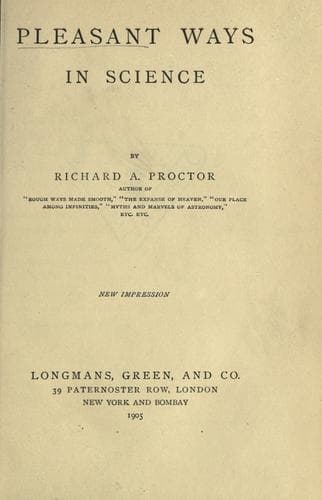
Pleasant Ways in ScienceProctor, Richard A. (Richard Anthony)
Science
Pleasant Ways in Science
Proctor, Richard A. (Richard Anthony)
Science
Vögel’s earlier observations agreed well with Cornu’s. He remarks,
however, that Cornu’s opinion as to the exact resemblance of the
chemical constitution of the star’s atmosphere with that of the sierra
is not just, for both Cornu and himself noticed one line which did not
correspond with any line belonging to the solar sierra; and this line
eventually became the brightest line of the whole spectrum. Comparing
his own observations with those of Cornu, Vögel points out that they
agree perfectly with regard to the presence of the three hydrogen
lines, and that of the brightest line of the air spectrum (belonging to
nitrogen),—which is the principal line of the spectrum of nebulæ. This
is the line which has no analogue in the spectrum of the sierra.
We have also observations by F. Secchi, at Rome, Mr. Copeland, at
Dunecht, and Mr. Backhouse, of Sunderland, all agreeing in the main
with the observations made by Vögel and Cornu. In particular, Mr.
Backhouse observed, as Vögel had done, that whereas in December the
greenish-blue line of hydrogen, F, was brighter than the nitrogen line
(also in the green-blue, but nearer the red end than F), on January 6
the nitrogen line was the brightest of all the lines in the spectrum of
the new star.
Vögel, commenting on the results of his observations up to March 10,
makes the following interesting remarks (I quote, with slight verbal
alterations, from a paraphrase in a weekly scientific journal):—“A
stellar spectrum with _bright_ lines is always a highly interesting
phenomenon for any one acquainted with stellar spectrum analysis,
and well worthy of deep consideration. Although in the chromosphere
(sierra) of our sun, near the limb, we see numerous bright lines, yet
only dark lines appear in the spectrum whenever we produce a small
star-like image of the sun, and examine it through the spectroscope. It
is generally believed that the bright lines in some few star-spectra
result from gases which break forth from the interior of the luminous
body, the temperature of which is higher than that of the surface of
the body—that is, the phenomenon is the same sometimes observed in
the spectra of solar spots, where incandescent hydrogen rushing out
of the hot interior becomes visible above the cooler spots through
the hydrogen lines turning bright. But this is not the only possible
explanation. We may also suppose that the atmosphere of a star,
consisting of incandescent gases, as is the case with our own sun, is
on the whole cooler than the nucleus, but with regard to the latter is
extremely large. I cannot well imagine how the phenomenon can last for
any long period of time if the former hypothesis be correct. The gas
breaking forth from the hot interior of the body will impart a portion
of its heat to the surface of the body, and thus raise the temperature
of the latter; consequently, the difference of temperature between the
incandescent gas and the surface of the body will soon be insufficient
Public-domain text, read in full here on John Shaqi.
Reviews
Reviews
No reviews yet
Be the first to share your thoughts on this work.
Elsewhere in the archive
Join the Discussion
Join the discussion
Sign in to leave a comment or review.
Sign InorCreate an account