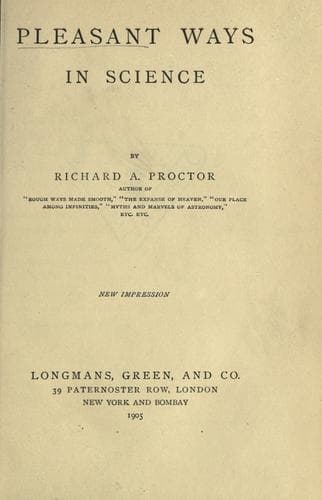
Pleasant Ways in ScienceProctor, Richard A. (Richard Anthony)
Science
Pleasant Ways in Science
Proctor, Richard A. (Richard Anthony)
Science
to produce bright lines; and these will disappear from the spectrum.
This view applies perfectly to stars which suddenly appear and soon
disappear again, or at least increase considerably in intensity—that
is, it applies perfectly to so-called new stars in the spectra of
which bright lines are apparent, _if_ the hypothesis presently to be
mentioned is admitted for their explanation. For a more stable state
of things the second hypothesis seems to be far better adapted. Stars
like Beta Lyræ, Gamma Cassiopeiæ, and others, which show the hydrogen
lines and the sierra D line bright on a continuous spectrum, with
only slight changes of intensity, possess, according to this theory,
atmospheres very large relatively to their own volume—the atmospheres
consisting of hydrogen and that unknown element which produces the
D line.[16] With regard to the new star, Zöllner, long before the
progress lately made in stellar physics by means of spectrum analysis,
deduced from Tycho’s observations of the star called after him, that
on the surface of a star, through the constant emission of heat, the
products of cooling, which in the case of our sun we call sun-spots,
accumulate: so that finally the whole surface of the body is covered
with a colder stratum, which gives much less light or none at all.
Through a sudden and violent tearing up of this stratum, the interior
incandescent materials which it encloses must naturally break forth,
and must in consequence, according to the extent of their eruption,
cause larger or smaller patches of the dark envelope of the body to
become luminous again. To a distant observer such an eruption from the
hot and still incandescent interior of a heavenly body must appear as
the sudden flashing-up of a new star. That this evolution of light
may under certain conditions be an extremely powerful one, could be
explained by the circumstance that all the chemical compounds which,
under the influence of a lower temperature, had already formed upon the
surface, are again decomposed through the sudden eruption of these hot
materials; and that this decomposition, as in the case of terrestrial
substances, takes place under evolution of light and heat. Thus the
bright flashing-up is not only ascribed to the parts of the surface
which through the eruption of the incandescent matter have again become
luminous, but also to a simultaneous process of combustion, which is
initiated through the colder compounds coming into contact with the
incandescent matter.”
Public-domain text, read in full here on John Shaqi.
Reviews
Reviews
No reviews yet
Be the first to share your thoughts on this work.
Elsewhere in the archive
Join the Discussion
Join the discussion
Sign in to leave a comment or review.
Sign InorCreate an account