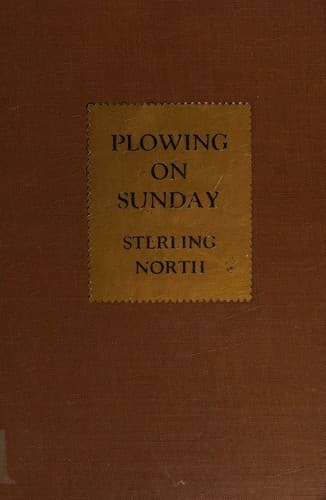
Farm life -- Fiction; United States -- Social life and customs -- 20th century -- Fiction; Wisconsin -- Fiction
"You don't need to holler at me," said Old Mrs. Crandall. "I ain't
as hard of hearing as all that."
She pulled her shawl a little tighter about her rheumatic
shoulders, and cocked a sly old ear for the salty gossip Sister
Atwell was passing on to Sister Bailey.
Girls of high school age, whispering and giggling, twisted long
streamers of red, white, and blue crêpe paper in dizzy crescents
from pillar to pillar of the festive room, while over each blazing
chromo the same laughing girls hung shooting stars, bluebells,
anemones, and other spring flowers.
The chromos were of the unforgettable period in religious art which
offered holy scenes in dazzling triads, stirring masterpieces which
could not help but move saints and sinners alike, pictures which
carried a message and a warning. "Rock of Ages Cleft for Me" with
a courageous lady in a white nightgown hanging perilously to a
granite cross amid seas which would have sunk the _Titanic_; an
amazingly tinted "Last Supper"; Christ driving the money changers
from the temple with a ferocious rawhide blacksnake which Stud
Brailsford privately admitted a man would not use on a team of
balky mules.
Flowers were also heaped upon the golden oak upright piano, lacking
three ivories, sadly out of tune, and showing unmistakable battle
scars from the militant hammering it received during every Sunday
School session, no less than from the attempts of Epworth League
members to "rag" such sacred selections as "Holy, Holy, Holy."
The kitchen was a mad-house. Along ten feet of glowing griddles
perspiring sisters of the Ladies' Aid were stewing chickens,
thickening gravy, starting great pots of coffee (two hours before
suppertime with the result that church supper coffee had a wallop
like 100 proof Bourbon) cutting slices of home-baked bread,
quartering apple, pumpkin, and gooseberry pies, whipping half
gallons of Jersey cream in wooden bowls two feet in diameter,
pouring into boat-shaped cut-glass dishes jars of pickles, glass
after glass of jams, jellies and preserves.
Crocks of golden butter and creamy cottage cheese made a formidable
bulwark of richly laden earthenware in one corner, while a phalanx
of ice cream freezers stood guard beside the kitchen door. And
never except in time of war were seen such tubs of potatoes and
kettles of peas.
Thirty tables for which thirty women had each brought her largest
tablecloth were being set with six hundred ironware plates and
as many indestructible cups and saucers, while what was smilingly
known as the church silverware was lined up, knife, fork and spoon
at the right of every plate.
It was the scandal of the Ladies' Aid that some of these pieces
of husky serviceware were not stamped as they should have been
with "Property of the Methodist Episcopal Church" but were labeled
instead "Property of the First Congregational Church" or, breath of
popery, heresy and damnation, "Property of the St. James Catholic
Church."
Public-domain text, read in full here on John Shaqi.
Reviews
Reviews
No reviews yet
Be the first to share your thoughts on this work.
Join the Discussion
Join the discussion
Sign in to leave a comment or review.
Sign InorCreate an account