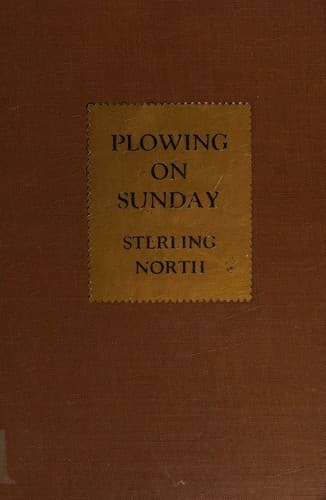
Farm life -- Fiction; United States -- Social life and customs -- 20th century -- Fiction; Wisconsin -- Fiction
As Stud followed the Rock River toward its source he watched the
stream grow smaller and smaller. He passed through Jefferson
and Watertown, neat towns in the midst of prosperous country.
On every side were the white-washed milk houses and bright red
barns of thrifty German farmers. The corn rustled, windmills
whirred, and bob-o-links scattered their liquid notes. He passed
busy creameries, a brewery, and a cross-road store, and still his
chariot wheeled on.
But as he climbed a hill giving a view of the rich valley and miles
of winding river, a tire expired with a long, soft sigh; and it was
an hour later after a mortal struggle with tire irons, pump, jack,
and obstinate valve-stems, that he was on his way again. Soon after
the engine coughed and died. He was out of gas.
Courteous drivers of that all but forgotten era when a Ford was a
fraternal emblem more binding than a Masonic button drew up with
boiling radiators and shrieking brakes to shout, "Need a lift,
friend?" It was one of these cheerful fellow motorists who drove
him three miles and back for a gallon of gasoline.
He stopped over night at a farm where the big German farmer and
his apple-dumpling wife would have been ashamed to even think of
charging for their hospitality. He was impressed by the clean barns
and white-washed trees, and spent several hours with the genial
farmer examining his Holsteins.
The next day he drove on to Horicon.
He came at last to the desolate marshes which seem to stretch
interminably across the wide valley of the upper reaches of the
Rock,--endless channels and pools, acres of billowing swamp grass,
millions of yellow pond lilies, red-wing blackbirds chattering in
hordes upon the swaying cat-tails.
Asking for Sherman, for Bedermier, and for Sherman again and
hearing this and that disturbing bit of their history until at last
he knew the whole sordid tale, he made his way along one of the
most desolate roads he had ever traversed. Huts among the gravel
hills bordering the marsh were over-run with chickens, pigs, and
dirty children. Pot-bellied women came to the door to see him pass.
He lost his way during the afternoon and had to retrace his path
over ruts and ditches which threatened at every moment to break
a spring. Toward sunset he arrived at the deserted Sherman place
and drove in through the stumps of a once generous orchard where
wheel-less wagons, overturned plows, and rusty cultivators vied
with sagging fences to make the spot as uninviting as can be
imagined.
There was scarcely an unbroken window left in the ramshackle
farmhouse; the windmill was down. Plantain and burrs had crept
into the barnyard, and the fields were giving way on every hand to
brambles, sumac and willows.
Public-domain text, read in full here on John Shaqi.
Reviews
Reviews
No reviews yet
Be the first to share your thoughts on this work.
Join the Discussion
Join the discussion
Sign in to leave a comment or review.
Sign InorCreate an account