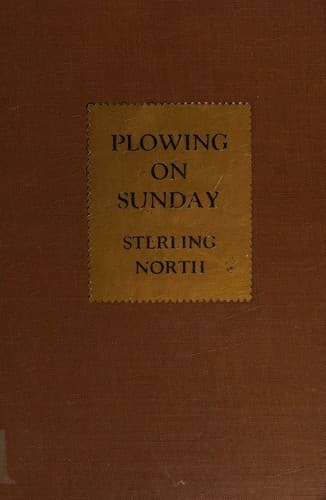
Farm life -- Fiction; United States -- Social life and customs -- 20th century -- Fiction; Wisconsin -- Fiction
Stud tried to straighten his back at the end of the row. The sweat
poured from his temples and the grizzled creases of his stubbled
cheeks. The pain went in wide, flat bands down the heavy muscles on
either side of his spine.
It was weakness to show this pain. One must laugh, throw down the
shining tobacco hatchet beside the shagbark hickory, snatch up the
heavy, brown-earthenware jug, tip it deftly over the shoulder and
slosh long, cool swigs of cider down one's parched and dusty throat.
"Uuufff, Uuuggg," said the big tobacco harvester, wiping his mouth
with the back of his sleeve and spitting into the dust. "Sure
tastes good, don't it?"
"Fair to middling," said Gus.
"It's darn good cider," said Ansel Ottermann, "even iffen it is
full of rotten apples and worms and such."
"Don't need to drink no more than you like," said Stud, holding the
jug just out of Ansel's reach. "Is it good cider or ain't it?"
"It's good cider," Ansel said.
The almanac had predicted early frost that year, and although the
entire family scoffed at almanac predictions Stud had cleaned and
sharpened his tobacco axes, suckered his tobacco plants, cleaned
out the sheds and gathered together a crew.
On the stroke of six one hazy blue Indian summer morning the
noisy crowd of farmers and men from Brailsford Junction began
the backbreaking labor. Up one row and down the next went the
sweating workers. The left hand grasped the stalk, the right sent
the tobacco hatchet cleanly through the heavy-fibered stem. Flash,
flash went the bright steel in the sunlight.
"Great crop this year," said Vern Barton. "Just heft them stalks."
"Too darned good a crop," growled Gus. "I got a crick in my back
like a he-dog in April."
"That's what you get gallivantin' around nights," said Stud. The
men laughed.
"How you do talk," said Gus. "You know I ain't took a girl into a
haymow for twenty years."
"How about a cornfield?" Stud asked.
Laths tipped with steel were spudded through the butt ends of the
stalks--five or six plants to each lath. The tobacco was then
loaded upon wagons and hauled to the sheds. Men climbed nimbly
among the poles hanging the heavily laden laths, tier upon tier.
The hot, suffocating air was pungent with the smell of green
tobacco.
The thick, moss-green leaves were soft and heavy as velvet to the
touch. Later they would be brown and brittle. Still later, when to
the vast excitement of the countryside "case" weather began, they
would be fine and pliable as thin brown leather.
The swallows had gathered long weeks before, and, as though at some
invisible signal sent along the thousands of miles of wire on which
they were mobilized, had left over night for the south. The fields
were strewn with yellowing pumpkins and swelling hubbard squashes,
knobbed, burly, and deep green. The first ducks were dropping in
from the north. Soon it would be time for the Rock County Fair.
Public-domain text, read in full here on John Shaqi.
Reviews
Reviews
No reviews yet
Be the first to share your thoughts on this work.
Join the Discussion
Join the discussion
Sign in to leave a comment or review.
Sign InorCreate an account