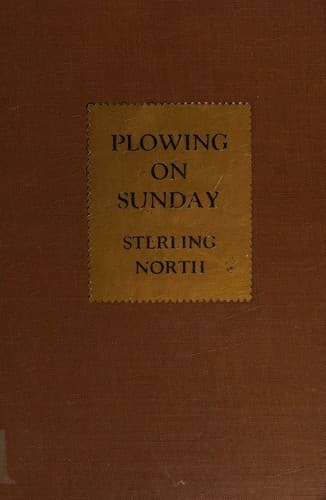
Farm life -- Fiction; United States -- Social life and customs -- 20th century -- Fiction; Wisconsin -- Fiction
He whistled happily as he rolled up his sleeves, showing huge brown
arms with bulging biceps, tied on a leather apron, and lifting
the heavy hammer gave the anvil a couple of preparatory whangs,
bell-like strokes which rang out across the valley of the stream
all the way to Cottonwood Hill and back again.
"Blamed if I don't like shoeing a horse," he told the sorrel.
"Nothing like it to set a fellow up in the morning."
Stud had a weakness for his blacksmith shop and the adjoining mill
which had once ground all the grist and cut all the lumber for the
entire countryside. The old stone building was in ruins now, the
mill-wheel fallen, and the dam washed away, moss and vines covered
the rotting roof; but Stud would not tear it down.
He liked to come down here on a wet day and tinker around in the
pile of wheels and machine parts which littered the floor. At a
bench in one corner he kept his paraphernalia for stuffing birds,
in another his saws and planes and chisels, his brace and bits
and other woodworking equipment. He liked to make things, and fix
things, and whang away at his anvil.
"Have to fix that bellows with a new cowskin," he announced to no
one in particular. "Must have been made before the Civil War by my
Granddaddy--and what a great old fellow he was!" Stud fished the
glowing crescent of iron out of the coals and set to work with his
hammer.
"Tailor made shoes for a pretty lady," he told the anxious mare.
"Can't go barefoot like a blamed little foal."
So he had heard his father talk to sleek and shining mares in this
same blacksmith shop, and so his father's father had doubtless
talked to _his_ horses on this very spot. Stud had a sneaking
fondness for horses and ancestors. Particularly the big men who had
come swinging into Wisconsin in the eighteen-forties to open up
this country as if by miracle.
He had heard his father tell of the stormy voyage from England in a
sailing ship, the long journey up the canal and through the Great
Lakes, the landing at Milwaukee where the candle-lit taverns were
over-run with settlers, frontier merchants, gamblers, whores, and
itinerant ministers of the gospel who shared the unpartitioned
floors, and waded democratically through the deep mud in the tavern
yard where scores of oxen were tethered beside their clumsy carts.
Stud himself remembered the last of these "toad-crushers" with
wheels cut from cross-sections of huge oak trees. Loaded with lead
and pulled by as many as eight yoke of oxen, these carts drew the
metal mined in Galena and Exeter across the wilds of intervening
Wisconsin to the lake port of Milwaukee. The drivers were a wild
and frisky crew, Stud had been told. It shocked and titillated his
righteous old Daddy (who had watched the ox teams from this very
window) knowing how the drivers whored and played at cards in
Milwaukee and the thriving town of Galena.
Public-domain text, read in full here on John Shaqi.
Reviews
Reviews
No reviews yet
Be the first to share your thoughts on this work.
Join the Discussion
Join the discussion
Sign in to leave a comment or review.
Sign InorCreate an account