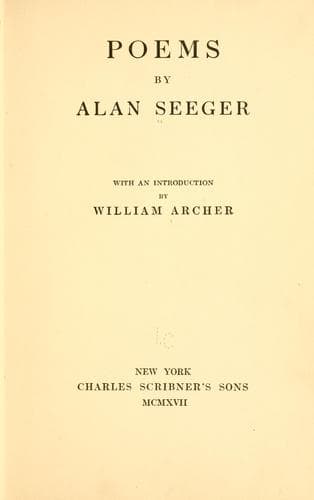
I do not, I repeat, pretend to measure him with Shelley, Byron or Keats,
though I think none of them would have disdained his gift of song.
But assuredly he is of their fellowship in virtue,
not only of his early death, but of his whole-hearted devotion
to the spirit of Romance, as they understood it. From his boyhood upward,
his one passion was for beauty; and it was in the guise of Romance
that beauty revealed itself to him. He was from the first determined
not only to write but to live Romance, and when fate threw in his way
a world-historic opportunity, he seized it with delight.
He knew that he was dicing with Death, but that was the very essence
of his ideal; and he knew that if Death won the throw,
his ideal was crowned and consummated, for ever safe
from the withering touch of time, or accidental soilure.
If it had been given to Swinburne to fall, rifle in hand,
on, say, the field of Mentana, we should have been the poorer
by many splendid verses, but the richer by a heroic life-story.
And would his lot have been the less enviable? Nay, surely, much the more.
That is the thought which may well bring solace to those
who loved Alan Seeger, and who may at first have felt as an unmixed cruelty
the cutting short of so eager, so generous, so gallant a life.
The description "Juvenilia" attached to the first series of these poems
is of his own choosing. It is for the reader to judge
what allowance is to be made for unripeness, whether of substance or of form.
Criticism is none of my present business. But I think no discerning reader
can fail to be impressed by one great virtue pervading all the poet's
work--its absolute sincerity. There is no pose, no affectation of any sort.
There are marks of the loving study of other poets, and these the best.
We are frequently reminded of this singer and of that. The young American
is instinctively loyal to the long tradition of English literature.
He is content to undergo the influence of the great masters,
and does not seek for premature originality on the by-paths of eccentricity.
But while he is the disciple of many, he is the vassal of none.
His matter is always his own, the fruit of personal vision, experience,
imagination, even if he may now and then unconsciously pour it into a mould
provided by another. He is no mere echo of the rhythms of this poet,
or mimic of that other's attitude and outlook. The great zest of living
which inspires him is far too real and intense to clothe itself
in the trappings of any alien individuality. He is too straightforward
to be even dramatic. It is not his instinct to put on a mask,
even for purposes of artistic personation, and much less of affectation.
Public-domain text, read in full here on John Shaqi.
Reviews
Reviews
No reviews yet
Be the first to share your thoughts on this work.
Join the Discussion
Join the discussion
Sign in to leave a comment or review.
Sign InorCreate an account