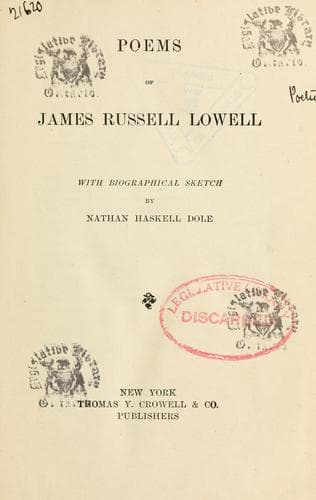
Poems of James Russell Lowell: With biographical sketch by Nathan Haskell Dole — John Shaqi
Poems of James Russell Lowell: With biographical sketch by Nathan Haskell DoleLowell, James Russell
General
Poems of James Russell Lowell: With biographical sketch by Nathan Haskell Dole
Lowell, James Russell
American poetry
He was extremely popular. Known in private as "one of the most
marvellous of story-tellers," he became the lion of many public
occasions. The _London News_ spoke of the "Extraordinary felicity of his
occasional speeches." At Birmingham he delivered a noble address on
Democracy. He was selected to deliver the oration at the dedication of
the Dean Stanley Memorial. He spoke on Fielding at Taunton, on Coleridge
at Westminster Abbey, on Gray at Cambridge. He was President of the
Wordsworth Society. All sorts of honors were heaped upon him, both at
home and abroad.
He returned to America in 1885, and once more occupied the somewhat
dilapidated historic mansion at Elmwood. Once more he moved amid his
rare and precious books, and heard the birds singing in the elms that
his father had planted, or in the clustered bushes back of the house. He
took a deep interest in the struggle for international copyright. He was
President of the American Copyright League, and wrote the memorable
lines:--
"In vain we call old notions fudge,
And bend our conscience to our dealing;
The Ten Commandments will not budge;
And stealing _will_ continue stealing."
He used the leisure of his failing health in revising his works. His
last volume of poems was entitled "Heart's Ease and Rue." One of his
latest poems, "My Book," appeared in the Christmas number of the New
York _Ledger_ in 1890. In the December number of the _Atlantic_ his hand
was visible in the anonymous "Contributor's Club."
During the last years his health was a matter of grave anxiety to his
friends. In the spring of 1891 he seemed better. He was engaged in
writing a life of Nathaniel Hawthorne. When the present writer call to
see him one beautiful spring day, he found him in his library, at that
moment engaged in making suggestions for the inscriptions on the new
Boston Public Library. His manner was the perfection of courtesy and
high breeding. His keen eyes seemed to read the very soul. Simplicity
and beautiful dignity, tempered by evident feebleness of health, made
him a memorable figure.
Toward the end of the summer he suddenly grew more seriously ill. He
suffered severely, and his last words were, "Oh! why don't you let me
die?"
He drew his last breath in the early morning of Aug. 12, 1891. He was
buried at Mount Auburn, in the shadow of Indian Ridge, not far from
Longfellow's grave, in a lot unenclosed and marked by no monument.
Memorial services were held in many places. Lord Tennyson cabled a
message of sympathy: "England and America will mourn Mr. Lowell's death.
They loved him and he loved them." The Queen publicly expressed her
respect and sorrow.
Few men have left a deeper impress on their age. Few men have used noble
powers more nobly. In private life and public station there is not a
shadow to stain the whiteness of his fame.
Public-domain text, read in full here on John Shaqi.
Reviews
Reviews
No reviews yet
Be the first to share your thoughts on this work.
Join the Discussion
Join the discussion
Sign in to leave a comment or review.
Sign InorCreate an account