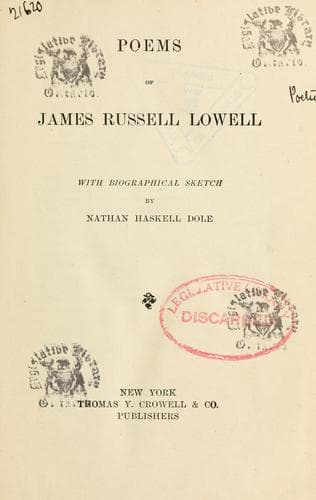
Poems of James Russell Lowell: With biographical sketch by Nathan Haskell DoleLowell, James Russell
General
Poems of James Russell Lowell: With biographical sketch by Nathan Haskell Dole
Lowell, James Russell
American poetry
As Want was the prime foe these hardy exodists had to fortress
themselves against, so it is little wonder if that traditional feud is
long in wearing out of the stock. The wounds of the old warfare were
long ahealing, and an east wind of hard times puts a new ache in every
one of them. Thrift was the first lesson in their hornbook, pointed out,
letter after letter, by the lean finger of the hard schoolmaster,
Necessity. Neither were those plump, rosy-gilled Englishmen that came
hither, but a hard-faced, atrabilious, earnest-eyed race, stiff from
long wrestling with the Lord in prayer, and who had taught Satan to
dread the new Puritan hug. Add two hundred years' influence of soil,
climate, and exposure, with its necessary result of idiosyncrasies, and
we have the present Yankee, full of expedients, half-master of all
trades, inventive in all but the beautiful, full of shifts, not yet
capable of comfort, armed at all points against the old enemy Hunger,
longanimous, good at patching, not so careful for what is best as for
what will _do_, with a clasp to his purse and a button to his pocket,
not skilled to build against Time, as in old countries, but against
sore-pressing Need, accustomed to move the world with no ποῦ στῶ but his
own two feet, and no lever but his own long forecast. A strange hybrid,
indeed, did circumstance beget, here in the New World, upon the old
Puritan stock, and the earth never before saw such mystic-practicalism,
such niggard-geniality, such calculating-fanaticism, such
cast-iron-enthusiasm, such sourfaced-humor, such
close-fisted-generosity. This new _Græculus esuriens_ will make a living
out of anything. He will invent new trades as well as tools. His brain
is his capital, and he will get education at all risks. Put him on Juan
Fernandez, and he would make a spelling-book first, and a salt-pan
afterward. _In cœlum, jusseris, ibit_,--or the other way either,--it is
all one, so anything is to be got by it. Yet, after all, thin,
speculative Jonathan is more like the Englishman of two centuries ago
than John Bull himself is. He has lost somewhat in solidity, has become
fluent and adaptable, but more of the original groundwork of character
remains. He feels more at home with Fulke Greville, Herbert of Cherbury,
Quarles, George Herbert, and Browne, than with his modern English
cousins. He is nearer than John, by at least a hundred years, to Naseby,
Marston Moor, Worcester, and the time when, if ever, there were true
Englishmen. John Bull has suffered the idea of the Invisible to be very
much fattened out of him. Jonathan is conscious still that he lives in
the world of the Unseen as well as of the Seen. To move John, you must
make your fulcrum of solid beef and pudding; an abstract idea will do
for Jonathan.
*.* TO THE INDULGENT READER.
Public-domain text, read in full here on John Shaqi.
Reviews
Reviews
No reviews yet
Be the first to share your thoughts on this work.
Elsewhere in the archive
Join the Discussion
Join the discussion
Sign in to leave a comment or review.
Sign InorCreate an account