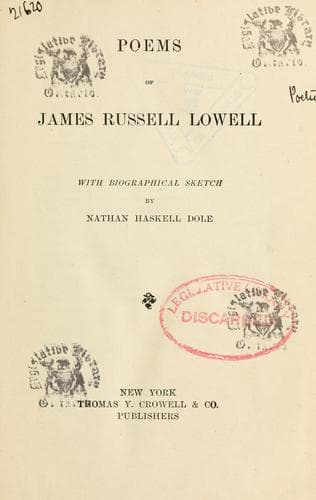
Poems of James Russell Lowell: With biographical sketch by Nathan Haskell DoleLowell, James Russell
General
Poems of James Russell Lowell: With biographical sketch by Nathan Haskell Dole
Lowell, James Russell
American poetry
My friend, the Reverend Mr. Wilbur, having been seized with
a dangerous fit of illness, before this Introduction had
passed through the press, and being incapacitated for all
literary exertion, sent to me his notes, memoranda, &c., and
requested me to fashion them into some shape more fitting
for the general eye. This, owing to the fragmentary and
disjointed state of his manuscripts, I have felt wholly
unable to do; yet, being unwilling that the reader should be
deprived of such parts of his lucubrations as seemed more
finished, and not well discerning how to segregate these
from the rest, I have concluded to send them all to the
press precisely as they are.
|Columbus Nye|,
_Pastor of a church in Bungtown Corner._
It remains to speak of the Yankee dialect. And, first, it may be
premised, in a general way, that any one much read in the writings of
the early colonists need not be told that the far greater share of the
words and phrases now esteemed peculiar to New England, and local there,
were brought from the mother country. A person familiar with the dialect
of certain portions of Massachusetts will not fail to recognize, in
ordinary discourse, many words now noted in English vocabularies as
archaic, the greater part of which were in common use about the time of
the King James translation of the Bible. Shakspeare stands less in need
of a glossary to most New Englanders than to many a native of the Old
Country. The peculiarities of our speech, however, are rapidly wearing
out. As there is no country where reading is so universal and newspapers
are so multitudinous, so no phrase remains long local, but is
transplanted in the mail-bags to every remotest corner of the land.
Consequently our dialect approaches nearer to uniformity than that of
any other nation.
The English have complained of us for coining new words. Many of those
so stigmatized were old ones by them forgotten, and all make now an
unquestioned part of the currency, wherever English is spoken.
Undoubtedly, we have a right to make new words, as they are needed by
the fresh aspects under which life presents itself here in the New
World; and, indeed, wherever a language is alive, it grows. It might be
questioned whether we could not establish a stronger title to the
ownership of the English tongue than the mother-islanders themselves.
Here, past all question, is to be its great home and centre. And not
only is it already spoken here by greater numbers, but with a higher
popular average of correctness, than in Britain. The great writers of
it, too, we might claim as ours, were ownership to be settled by the
number of readers and lovers.
Public-domain text, read in full here on John Shaqi.
Reviews
Reviews
No reviews yet
Be the first to share your thoughts on this work.
Elsewhere in the archive
Join the Discussion
Join the discussion
Sign in to leave a comment or review.
Sign InorCreate an account