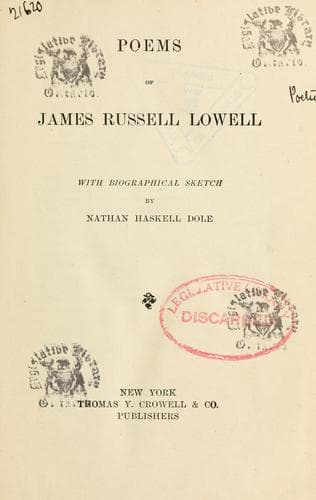
Poems of James Russell Lowell: With biographical sketch by Nathan Haskell Dole — John Shaqi
Poems of James Russell Lowell: With biographical sketch by Nathan Haskell DoleLowell, James Russell
General
Poems of James Russell Lowell: With biographical sketch by Nathan Haskell Dole
Lowell, James Russell
American poetry
"If I have any vocation, it is the making of verse. When I
take my pen for that, the world opens itself ungrudgingly
before me; everything seems clear and easy, as it seems
sinking to the bottom could be as one leans over the edge of
his boat in one of those dear coves at Fresh Pond.... My
true place is to serve the cause as a poet. Then my heart
leaps before me into the conflict."
The same year he began his "Biglow Papers" in the Boston _Courier_. Such
_jeux d'esprit_ are apt to be ephemeral. Lowell's are immortal. They
preserved in literary form a fast-fading dialect; they caught and
embalmed the mighty issues of a tremendous world-problem. Their
influence was incalculable. He gathered them into a volume in 1848, and
became corresponding editor of the _Anti-Slavery Standard_. Fortunate
man who throws himself into an unpopular cause which is in harmony with
the Right! How different from Wordsworth who attacked the ballot and
took sides against reform!
Lowell's penchant for satire was exemplified again the same year in his
"Fable for Critics."
In this Lowell with no sparing hand laid on his portraits most droll and
amusing colors. It is a comic portrait gallery, a series of caricatures
whose greatest value (as in all good caricatures) lies in the accurate
presentation of characteristic features. He did not spare himself:--
"There is Lowell, who's striving Parnassus to climb
With a whole bale of _isms_ tied together with rhyme.
He might get on alone, spite of troubles and bowlders,
But he can't with that bundle he has on his shoulders.
The top of the hill he will ne'er come nigh reaching
Till he learns the distinctions 'twixt singing and preaching;
His lyre has some chords that would ring pretty well,
But he'd rather by half make a drum of the shell,
And rattle away till he's old as Methusalem
At the head of a march to the last New Jerusalem."
Some of his thrusts left embittered feelings, but in general the tone
was so good-natured that only the thin-skinned could object, and it must
be confessed many of his judgments have been confirmed by Time.
In 1851 Lowell visited Europe, and spent upwards of a year widening his
acquaintance with the polite languages. But it is remarkable that Lowell
gave the world almost no metrical translations. Shortly after his return
his wife died (Oct. 27, 1853) after a slow decline. In reference to this
bereavement Longfellow wrote his beautiful poem, "The Two Angels."
The following year Longfellow resigned the Smith Professorship of the
French and Spanish Languages and Literature and Belles Lettres, and
Lowell was appointed his successor with two years' leave of absence. He
had won his spurs. He had collected his poems in two volumes, not
including "A Year's Life," the "Biglow Papers," or the "Fable for
Critics." He was known as one of the most brilliant contributors to
_Putnam's Monthly_ and other magazines.
Public-domain text, read in full here on John Shaqi.
Reviews
Reviews
No reviews yet
Be the first to share your thoughts on this work.
Join the Discussion
Join the discussion
Sign in to leave a comment or review.
Sign InorCreate an account