Children's poetry, English; English poetry -- 19th century
Transcriber’s Note: Italic text is enclosed in _underscores_.
[Illustration:
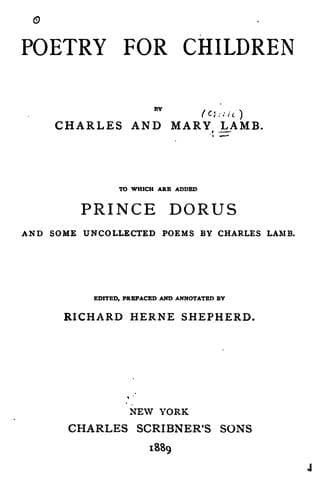
POETRY FOR
CHILDREN
BY
Charles and
Mary Lamb
ILLUSTRATED BY
WINIFRED GREEN
With a prefatory note by
ISRAEL GOLLANCZ
PUBLISHED BY J M DENT & Co
]
_To the
Gentle Reader_
_As often as I pass a little Blue-coat boy I gaze upon him lovingly:
I reverence the quaint vision of a bygone age called up by the long
blue gaberdine, the red leathern belt, the yellow stockings--a quaint
monkish figure still to be seen in crowded London streets, still adding
to their picturesqueness and ever-varying charm._
_You, too, dear Reader, have yourself probably asked the meaning of
the strange sight, as you have passed one of these English lads so
strangely attired. Perhaps you have been shown the famous old school,
in the midst of the bustle of London, surrounded by ugly warehouses,
offices, and shops; and you have seen the effigy of the Founder, “that
godly and royal child, King Edward the Sixth, the flower of the Tudor
name--the young flower that was untimely cropped as it began to fill
our land with its early odours--the boy-patron of boys--the serious and
holy child who walked with Cranmer and Ridley.”_
_Alas, London is no longer to be the home of these boys, and the
cloisters of the Old Grey Friars will soon moulder away, when the merry
noise of sports and revels cease to awaken them to life._
_As I looked through the bars the other day watching the boys at their
games, a strange fancy came to me. I thought I saw a pale and studious
“Grecian” (as they call the head boys of the school), and walking at
his side, with glittering eyes full of wonderment, was a younger lad--a
boy with crisply curling black hair, and with ruddy brown complexion,
and in his look so much lovableness and trustfulness, that I felt
myself envying the elder lad, whose hand rested so affectionately on
the shoulder of his friend. I drew near to listen to their talk. The
thoughtful Grecian was discoursing learnedly yet so sweetly about some
deep matter of philosophy: it seemed somewhat beyond the younger boy,
but he listened quietly, rapt in admiration. Suddenly the school-bell
sounded. “Hurry on, Charles! ‘’Mid deepest meditation sounds the
knell.’ That’s how your good old Elizabethans would put it. We’ll have
another talk after supper.” “I--I’ve n--not h--h--had o--one t--t--talk
y--yet, S ... T ... C,” stammered the other in reply: a painful
contrast to the sublime eloquence that flowed from his companion._
Public-domain text, read in full here on John Shaqi.
Reviews
Reviews
No reviews yet
Be the first to share your thoughts on this work.
Join the Discussion
Join the discussion
Sign in to leave a comment or review.
Sign InorCreate an account