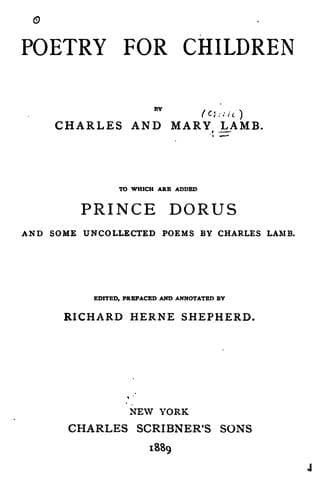
Children's poetry, English; English poetry -- 19th century
A little boy with crumbs of bread
Many a hungry sparrow fed.
It was a child of little sense
Who this kind bounty did dispense;
For suddenly ’twas from them torn,
And all the birds were left forlorn
In a hard time of frost and snow,
Not knowing where for food to go.
He would no longer give them bread,
Because he had observed, he said,
A great black bird, a rook by name,
That sometimes to the window came
And took away a small bird’s share.
So foolish Henry did not care
What became of the great rook
That from the little sparrows took,
Now and then, as ’twere by stealth,
A part of their abundant wealth;
[Illustration]
Nor ever more would feed his sparrows.
_Thus ignorance a kind heart narrows._
I wish I had been there, I would
Have told the child, rooks live by food
In the same way the sparrows do.
I also would have told him too
Birds act by instinct, and ne’er can
Attain the rectitude of man.
Nay, that even when distress
Does on poor human nature press,
We need not be too strict in seeing
The failings of a fellow-being.
[Illustration]
[Illustration: FEIGNED COURAGE]
XXIV
Horatio, of ideal courage vain,
Was flourishing in air his father’s cane,
And, as the fumes of valour swell’d his pate,
Now thought himself _this_ hero, and now _that_:
“And now,” he cried, “I will Achilles be;
My sword I brandish; see, the Trojans flee!
Now I’ll be Hector, when his angry blade
A lane through heaps of slaughter’d Grecians made!
And now my deeds, still, braver I’ll evince,
I am no less than Edward the Black Prince.
Give way, ye coward French!” As thus he spoke,
And aim’d in fancy a sufficient stroke
To fix the fate of Crecy or Poictiers
(The Muse relates the Hero’s fate with tears),
He struck his milk-white hand against a nail,
Sees his own blood, and feels his courage fail.
[Illustration]
Ah! where is now that boasted valour flown,
That in the tented field so late was shown?
Achilles weeps, great Hector hangs his head,
And the Black Prince goes whimpering to bed.
[Illustration]
[Illustration: HESTER]
XXV
When maidens such as Hester die,
Their place ye may not well supply,
Though ye among a thousand try
With vain endeavour.
A month or more hath she been dead,
Yet cannot I by force be led
To think upon the wormy bed,
And her together.
A springy motion in her gait,
A rising step, did indicate
Of pride and joy no common rate,
That flush’d her spirit.
I know not by what name beside
It may be call’d; if ’twas not pride,
It was a joy to that allied
She did inherit.
[Illustration]
Public-domain text, read in full here on John Shaqi.
Reviews
Reviews
No reviews yet
Be the first to share your thoughts on this work.
Join the Discussion
Join the discussion
Sign in to leave a comment or review.
Sign InorCreate an account