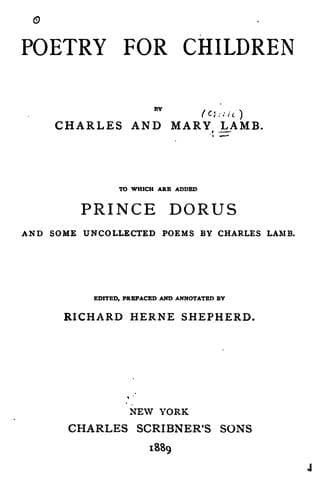
Children's poetry, English; English poetry -- 19th century
_Mary Lamb had something of her brother’s gift of writing; it was
she indeed to whom you owe many of the Tales of Shakespeare you are
so fond of. They loved children, and they loved Shakespeare, and
their stories from Shakespeare have been and are still read by boys
and girls all the world over. They wrote, too, a whole collection of
Poetry for Children, and here also Mary’s share was much greater than
her brother’s. “Mine,” wrote Charles, “are but one-third in quantity
of the whole.” ... “Perhaps you will admire the number of subjects,
all of children, picked out by an old bachelor and an old maid. Many
parents would not have found so many.” This collection of “Poetry for
Children” in two small volumes, was so much liked by the children that
all the copies were soon bought up, and Charles Lamb himself could not
get a copy, when later in life he sought one far and wide. So rare is
the book now that only one or two copies are known to exist, and even
the British Museum does not possess these precious little volumes. A
small selection of the poems are now once again offered to boys and
girls: if this prove welcome, more will follow. They are simple little
poems such as children should care for, and even grown-up people, for
whom they were never intended, cherish every word written by Mary and
Charles Lamb, because they know how much goodness and humility dwelt in
their souls. If there were any wish to be learned and to explain how
they came to write these verses, one would have to tell you something
about other writers who were then living and writing, more especially
about Lamb’s friend “S. T. C.,” who, together with an even greater
poet, William Wordsworth, had published ten years before, in 1798, a
small volume of simple English poems, which was destined to have the
greatest influence on English poetry for long years to come. In that
volume Wordsworth first printed the sweet little poem I am sure you
know, called_ We Are Seven, _and Coleridge, “the inspired charity boy,”
as Charles Lamb called him, gave the world the magical ballad of_ The
Ancient Mariner. _One verse from this ballad ought to be printed on the
title-page of this little book of poems by Mary and Charles Lamb:--_
_“He prayeth best, who loveth best
All things both great and small;
For the dear God who loveth us,
He made and loveth all.”_
_I. G._
[Illustration: CONTENTS]
PAGE
I. The First Tooth 11
II. The Boy and the Skylark--A Fable 14
III. The Rainbow 18
IV. Queen Oriana’s Dream 21
V. The Sister’s Expostulation on the Brother’s learning
Latin 23
Public-domain text, read in full here on John Shaqi.
Reviews
Reviews
No reviews yet
Be the first to share your thoughts on this work.
Join the Discussion
Join the discussion
Sign in to leave a comment or review.
Sign InorCreate an account