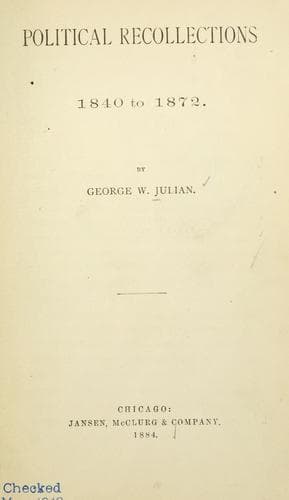
Political Recollections: 1840 to 1872Julian, George Washington
History
Political Recollections: 1840 to 1872
Julian, George Washington
Republican Party (U.S. : 1854- ) -- History; United States -- Politics and government
On the day following this battle Congress met as usual, and
undoubtedly shared largely in the general feeling. A little before
the battle General Mansfield had issued an order declaring that
fugitive slaves would under no circumstances whatever be permitted
to reside or be harbored in the quarters and camps of the troops
serving in his department; and now, both Houses of Congress promptly
and with great unanimity and studious emphasis declared that the
purpose of the war was not the "conquest" or "subjugation" of the
conspirators who were striking at the Nation's life, or the overthrow
of their "established institutions," but to defend "the supremacy
of the Constitution," and to "preserve the Union"; and that "as
soon as these objects are accomplished the war ought to cease."
To through-going anti-slavery men this seemed like an apology for
the war, and a most ill-timed revival of the policy of conciliation,
which had been so uniformly and contemptuously spurned by the enemy.
It failed utterly of its purpose, and this historic resolve of
Congress was only useful to the rebels, who never failed to wield
it as a weapon against us, after the teaching of events had compelled
us to make slavery the point of attack. The Confiscation Act of
the 6th of August was regarded as a child of the same sickly
ancestry. The section of the Act making free the slaves employed
against us by the rebels in their military operations was criticised
as a bribe to them to fight us, rather than a temptation to espouse
our cause. If they engaged in the war at all, they were obliged
to do so as our enemies; but if they remained at home on their
plantations in the business of feeding the rebel armies, they would
have the protection of both the loyal and Confederate Governments.
The policy of both parties to the struggle was thus subordinated
to the protection of slavery.
But on the 31st of August a new war policy was inaugurated by the
proclamation of General Fremont, giving freedom to the slaves of
rebels in his department. It was greeted by the people of the
Northern States with inexpressible gladness and thanksgiving. The
Republican press everywhere applauded it, and even such Democratic
and conservative papers as the "Boston Post," the "Detroit Free
Press," the "Chicago Times," and the "New York Herald" approved
it. During the ten days of its life all party lines seemed to be
obliterated in the fires of popular enthusiasm which it kindled,
and which was wholly unprecedented in my experience. I was then
on the stump in my own State, and I found the masses everywhere so
wild with joy, that I could scarcely be heard for their shouts.
As often as I mentioned the name of "Fremont," the prolonged hurrahs
of the multitude followed, and the feeling seemed to be universal
that the policy of "a war on peace principles" was abandoned, and
that slavery, the real cause of the war, was no longer to be the
chief obstacle to its prosecution.
Public-domain text, read in full here on John Shaqi.
Reviews
Reviews
No reviews yet
Be the first to share your thoughts on this work.
Elsewhere in the archive
Join the Discussion
Join the discussion
Sign in to leave a comment or review.
Sign InorCreate an account