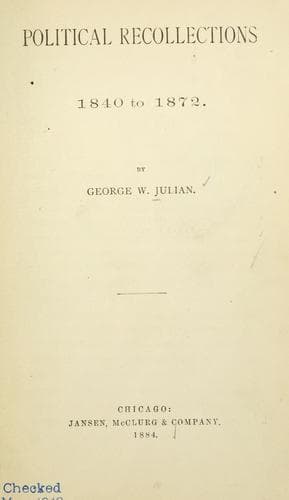
Political Recollections: 1840 to 1872Julian, George Washington
History
Political Recollections: 1840 to 1872
Julian, George Washington
Republican Party (U.S. : 1854- ) -- History; United States -- Politics and government
But in the midst of this great exultation and joy the President
annulled the proclamation because it went beyond the Confiscation
Act of the 6th of August, and was offensive to the Border States.
It was a terrible disappointment to the Republican masses, who
could not understand why loyal slaveholders in Kentucky should be
offended because the slaves of rebels in Missouri were declared
free. From this revocation of the new war policy, dated the pro-
slavery reaction which at once followed. It balked the popular
enthusiasm which was drawing along with it multitudes of conservative
men. It caused timid and halting men to become cowards outright.
It gave new life to slavery, and encouraged fiercer assaults upon
"abolitionism." It revived and stimulated Democratic sympathy for
treason wherever it had existed, and necessarily prolonged the
conflict and aggravated its sorrows; while it repeated the ineffable
folly of still relying upon a policy of moderation and conciliation
in dealing with men who had defiantly taken their stand outside of
the Constitution and laws, and could only be reached by the power
of war.
When Congress met in December, the policy of deference to slavery
still continued. The message of the President was singularly
dispassionate, deprecating "radical and extreme measures," and
recommending some plan of colonization for the slaves made free by
the Confiscation Act. Secretary Cameron, however, surprised the
country by the avowal of a decidedly anti-slavery war policy in
his report; but in a discussion in the House early in December, on
General Halleck's "Order No. Three," I took occasion to expose his
insincerity by referring to his action a little while before in
restoring to her master a slave girl who had fled to the camp of
Colonel Brown, of the Twentieth Indiana regiment, who had refused
to give her up. On the nineteenth of December, a joint select
Committee on the Conduct of the War was appointed, composed of
three members of the Senate and four members of the House. The
Senators were B. F. Wade, of Ohio; Z. Chandler, of Michigan, and
Andrew Johnson, of Tennessee; and the House members were John
Covode, of Pennsylvania; M. F. Odell, of New York; D. W. Gooch, of
Massachusetts, and myself. The committee had its birth in the
popular demand for a more vigorous prosecution of the war, and less
tenderness toward slavery; and I was gratified with my position on
it because it afforded a very desirable opportunity to learn
something of the movements of our armies and the secrets of our
policy.
Public-domain text, read in full here on John Shaqi.
Reviews
Reviews
No reviews yet
Be the first to share your thoughts on this work.
Elsewhere in the archive
Join the Discussion
Join the discussion
Sign in to leave a comment or review.
Sign InorCreate an account