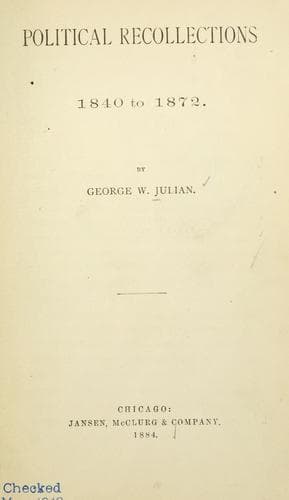
Political Recollections: 1840 to 1872Julian, George Washington
History
Political Recollections: 1840 to 1872
Julian, George Washington
Republican Party (U.S. : 1854- ) -- History; United States -- Politics and government
On the sixth of January, by special request of the President, the
committee met him and his Cabinet at the Executive Mansion, to
confer about the military situation. The most striking fact revealed
by the discussion which took place was that neither the President
nor his advisers seemed to have any definite information respecting
the management of the war, or the failure of our forces to make
any forward movement. Not a man of them pretended to know anything
of General McClellan's plans. We were greatly surprised to learn
that Mr. Lincoln himself did not think he had any _right_ to know,
but that, as he was not a military man, it was his duty to defer
to General McClellan. Our grand armies were ready and eager to
march, and the whole country was anxiously waiting some decisive
movement; but during the delightful months of October, November
and December, they had been kept idle for some reason which no man
could explain, but which the President thought could be perfectly
accounted for by the General-in-Chief. Secretary Cameron said he
knew nothing of any plan for a forward movement. Secretary Seward
had entire confidence in General McClellan, and thought the demand
of the committee for a more vigorous policy uncalled for. The
Postmaster-General made no definite avowals, while the other members
of the Cabinet said nothing, except Secretary Chase, who very
decidedly sympathized with the committee in its desire for some
early and decisive movement of our forces. The spectacle seemed
to us very disheartening. The testimony of all the commanding
generals we had examined showed that our armies had been ready to
march for months; that the weather and roads had been most favorable
since October; and that the Army of the Potomac was in a fine state
of discipline, and nearly two hundred thousand strong, while only
about forty thousand men were needed to make Washington perfectly
safe. Not a general examined could tell why this vast force had
so long been kept idle, or what General McClellan intended to do.
The fate of the nation seemed committed to one man called a "General-
in-Chief," who communicated his secrets to no human being, and who
had neither age nor military experience to justify the extraordinary
deference of the President to his wishes. He had repeatedly appeared
before the committee, though not yet as a witness, and we could
see no evidence of his pre-eminence over other prominent commanders;
and it seemed like a betrayal of the country itself to allow him
to hold our grand armies for weeks and months in unexplained
idleness, on the naked assumption of his superior wisdom. Mr.
Wade, as Chairman of the committee, echoed its views in a remarkably
bold and vigorous speech, in which he gave a summary of the principal
facts which had come to the knowledge of the committee, arraigned
General McClellan for the unaccountable tardiness of his movements,
and urged upon the Administration, in the most undiplomatic plainness
Public-domain text, read in full here on John Shaqi.
Reviews
Reviews
No reviews yet
Be the first to share your thoughts on this work.
Elsewhere in the archive
Join the Discussion
Join the discussion
Sign in to leave a comment or review.
Sign InorCreate an account