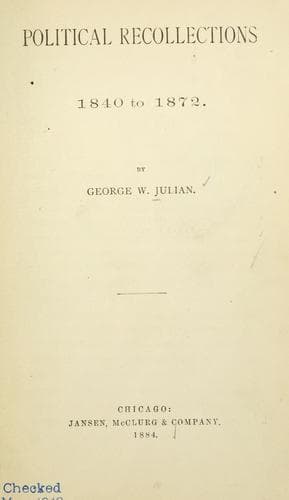
Political Recollections: 1840 to 1872Julian, George Washington
History
Political Recollections: 1840 to 1872
Julian, George Washington
Republican Party (U.S. : 1854- ) -- History; United States -- Politics and government
On approaching Centreville the first object that attracted our
attention was one of the huge earthworks of the enemy, with large
logs placed in the embrasures, the ends pointing toward us, and
painted black in imitation of cannon. The earthworks seemed very
imperfectly constructed, and from this fact, and the counterfeit
guns which surmounted them, it was evident that no fight had been
seriously counted on by the absconding forces. The substantial
character of their barracks, bake-ovens, stables, and other
improvements, confirmed this view; and on reaching Manassas we
found the same cheap defenses and the same evidences of security,
while the rebel forces were much less than half as great as ours,
and within a day's march from us. What was the explanation of all
this? Why had we not long before, driven in the rebel pickets,
and given battle to the enemy, or at least ascertained the facts
as to the weakness of his position? Could the commander be loyal
who had opposed all the previous forward movements of our forces,
and only made this advance after the enemy had evacuated? These
were the questions canvassed by the members of the committee in
their passionate impatience for decisive measures, and which they
afterward earnestly pressed upon the President as a reason for
relieving General McClellan of his command. They were also greatly
moved by the fact already referred to, that General McClellan had
neglected and repeatedly refused to co-operate with the navy in
breaking up the blockade of the Potomac, which could have been done
long before according to the testimony of our commanders, while he
had disobeyed the positive order of the President respecting the
defenses of Washington by reserving only nineteen thousand imperfectly
disciplined men for that service, through which the capital had
been placed at the mercy of the enemy. Meanwhile the flame of
popular discontent had found further fuel in the threats of McClellan
to put down slave insurrections "with an iron hand," and his order
expelling the Hutchinsons from the Army of the Potomac for singing
Whittier's songs of liberty. Of course I am not dealing with the
character and capacity of General McClellan as a commander, but
simply depicting the feeling which extensively prevailed at this
time, and which justified itself by hastily accepting merely apparent
facts as conclusive evidence against him.
Public-domain text, read in full here on John Shaqi.
Reviews
Reviews
No reviews yet
Be the first to share your thoughts on this work.
Elsewhere in the archive
Join the Discussion
Join the discussion
Sign in to leave a comment or review.
Sign InorCreate an account