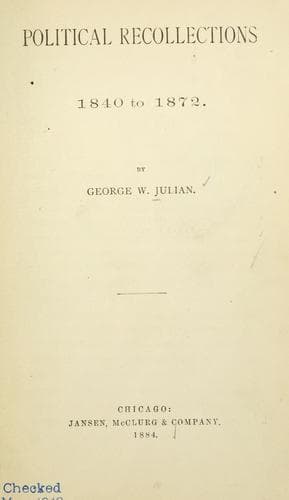
Political Recollections: 1840 to 1872Julian, George Washington
History
Political Recollections: 1840 to 1872
Julian, George Washington
Republican Party (U.S. : 1854- ) -- History; United States -- Politics and government
On the 24th day of March, Secretary Stanton sent for the committee
for the purpose of having a confidential conference as to military
affairs. He was thoroughly discouraged. He told us the President
had gone back to his first love as to General McClellan, and that
it was needless for him or for us to labor with him, although he
had finally been prevailed on to restrict McClellan's command to
the Army of the Potomac. The Secretary arraigned the General's
conduct in the severest terms, particularizing his blunders, and
branding them. He told us the President was so completely in the
power of McClellan that he had recently gone to Alexandria in person
to ask him for some troops from the Army of the Potomac for General
Fremont, which were refused. He said he believed there were traitors
among the commanders surrounding General McClellan, and if he had
had the power he would have dismissed eight commanders when the
wooden-gun discovery was made; and he fully agreed with us as to
the disgraceful fact that our generals had not long before discovered,
as they could have done, the real facts as to the rebel forces and
their defences.
It was quite evident from these facts that Stanton, with all his
force of will, did not rule the President, as the public has
generally supposed. He would frequently overawe and sometimes
browbeat others, but he was never imperious in dealing with Mr.
Lincoln. This I have from Mr. Watson, for some time Assistant
Secretary of War, and Mr. Whiting, while Solicitor of the War
Department. Lincoln, however, had the highest opinion of Stanton,
and their relations were always most kindly, as the following
anecdote bears witness: A committee of Western men, headed by
Lovejoy, procured from the President an important order looking to
the exchange and transfer of Eastern and Western soldiers with a
view to more effective work. Repairing to the office of the
Secretary, Mr. Lovejoy explained the scheme, as he had before done
to the President, but was met with a flat refusal.
"But we have the President's order, sir," said Lovejoy.
"Did Lincoln give you an order of that kind?" said Stanton.
"He did, sir."
"The he is a d----d fool," said the irate secretary.
"Do you mean to say the President is a d----d fool?" asked Lovejoy,
in amazement.
"Yes, sir, if he gave you such an order as that."
The bewildered Illinoisan betook himself at once to the President,
and related the result of his conference.
"Did Stanton say I was a d----d fool?" asked Lincoln at the close
of the recital.
"He did, sir, and repeated it."
After a moment's pause, and looking up, the President said, "If
Stanton said I was a d----d fool, then I must be one, for he is
nearly always right, and generally says what he means. I will step
over and see him."
Whether this anecdote is literally true or not, it illustrates the
character of the two men.
Public-domain text, read in full here on John Shaqi.
Reviews
Reviews
No reviews yet
Be the first to share your thoughts on this work.
Elsewhere in the archive
Join the Discussion
Join the discussion
Sign in to leave a comment or review.
Sign InorCreate an account