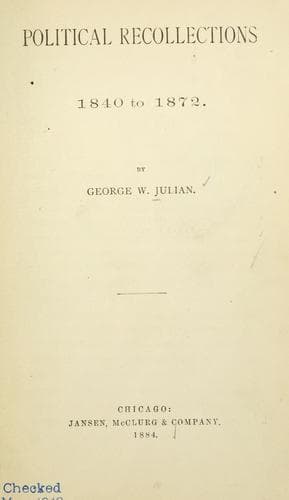
Political Recollections: 1840 to 1872Julian, George Washington
History
Political Recollections: 1840 to 1872
Julian, George Washington
Republican Party (U.S. : 1854- ) -- History; United States -- Politics and government
This picture of party politics, forty-three years ago, is not very
flattering to our American pride, but it simply shows the working
of Democratic institutions in dealing with the "raw material" of
society and life at that time. The movement of 1840 was necessarily
transient and provisional, while underneath its clatter and nonsense
was a real issue. It was unrecognized by both parties, but it made
its advent, and the men who pointed its way quietly served notice
upon the country of their ulterior purposes.
As long ago as the year 1817, Charles Osborn had established an
anti-slavery newspaper in Ohio, entitled "The Philanthropist,"
which was followed in 1821 by the publication of Benjamin Lundy's
"Genius of Universal Emancipation." In 1831 the uprising of slaves
in Southampton County, Virginia, under the lead of Nat. Turner,
had startled the country and invited attention to the question of
slavery. In the same year Garrison had established "The Liberator,"
and in 1835 was mobbed in Boston, and dragged through its streets
with a rope about his neck. In 1837 Lovejoy had been murdered in
Alton, Illinois, and his assassins compared by the Mayor of Boston
to the patriots of the Revolution. In 1838 a pro-slavery mob had
set fire to Pennsylvania Hall, in Philadelphia, and defied the city
authorities in this service of slavery. President Jackson and Amos
Kendall, his Postmaster General, had openly set the Constitution
at defiance by justifying the rifling of the mails and the suppression
of the circulation of anti-slavery newspapers in the South. The
"gag" resolutions had been introduced in the House of Representatives
in 1836, which provoked the splendid fights of Adams, Giddings and
Slade for the right of petition and the freedom of speech. Dr.
Channing had published his prophetic letter to Henry Clay, on the
annexation of Texas, in 1837, and awakened a profound interest in
the slavery question on both sides of the Atlantic. We had been
disgraced by two Florida wars, caused by the unconstitutional
espousal of slavery by the General Government. President Van Buren
had dishonored his administration and defied the moral sense of
the civilized world by his efforts to prostitute our foreign policy
to the service of slavery and the slave trade. In February, 1839,
Henry Clay had made his famous speech on "Abolitionism," and thus
recognized the bearing of the slavery question upon the presidential
election of the following year. The Abolitionists had laid siege
to the conscience and humanity of the people, and their moral
appeals were to be a well-spring of life to the nation in its final
struggle for self-preservation; but as yet they had agreed upon no
organized plan of action against the aggressions of an institution
which threatened the overthrow of the Union and the end of Republican
government. But now they were divided into two camps, the larger
of which favored political action, organized as a party, and
Public-domain text, read in full here on John Shaqi.
Reviews
Reviews
No reviews yet
Be the first to share your thoughts on this work.
Join the Discussion
Join the discussion
Sign in to leave a comment or review.
Sign InorCreate an account