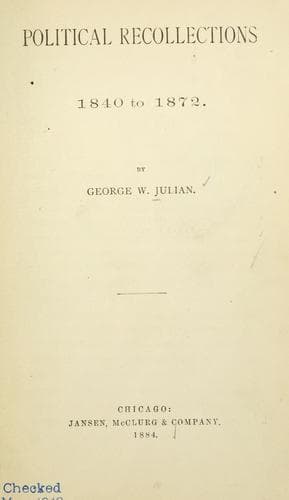
Political Recollections: 1840 to 1872Julian, George Washington
History
Political Recollections: 1840 to 1872
Julian, George Washington
Republican Party (U.S. : 1854- ) -- History; United States -- Politics and government
On New Year's day I joined the immense throng of callers at the
White House, but did not enjoy the delay of the President in issuing
his Proclamation of Emancipation. It came late in the day, and
brought relief to multitudes of anxious people. Perhaps no subject
has ever been more widely misunderstood than the legal effect of
this famous document, and the circumstances under which it was
issued. Mr. Lincoln was himself opposed to the measure, and when
he very reluctantly issued his preliminary proclamation in September,
he wished it distinctly understood that the deportation of the
slaves was, in his mind, inseparably connected with the policy.
Like Mr. Clay and other prominent leaders of the old Whig party,
he believed in colonization, and that the separation of the two
races was necessary to the welfare of both. He was at that time
pressing upon the attention of Congress a scheme of colonization
in Chiriqui in Central America, which Senator Pomeroy espoused with
great zeal, and in which he had the favor of a majority of the
Cabinet, including Secretary Smith, who warmly endorsed the project.
Subsequent development, however, proved that it was simply an
organization for land-stealing and plunder, and it was abandoned;
but it is by no means certain that if the President had foreseen
this fact, his preliminary notice to the rebels would have been
given. There are strong reasons for saying that he doubted his
right to emancipate under the war power, and that he meant what he
said when he compared an executive order to that effect to the
"Pope's Bull against the Comet."
But he saw no way of escape. The demand for such an edict was wide-
spread and rapidly extending in the Republican party. The power
to issue it was taken for granted. All doubts on the subject were
consumed in the burning desire of the people, or forgotten in the
travail of war. The anti-slavery element was becoming more and
more impatient and impetuous. Opposition to that element now
involved more serious consequences than offending the Border States.
Mr. Lincoln feared that enlistments would cease, and that Congress
would even refuse the necessary supplies to carry on the war, if
he declined any longer to place it on a clearly defined anti-slavery
basis. It was in yielding to this pressure that he finally became
the liberator of the slaves through the triumph of our arms which
it ensured.
Public-domain text, read in full here on John Shaqi.
Reviews
Reviews
No reviews yet
Be the first to share your thoughts on this work.
Elsewhere in the archive
Join the Discussion
Join the discussion
Sign in to leave a comment or review.
Sign InorCreate an account