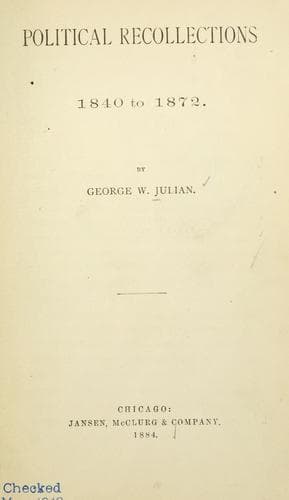
Political Recollections: 1840 to 1872Julian, George Washington
History
Political Recollections: 1840 to 1872
Julian, George Washington
Republican Party (U.S. : 1854- ) -- History; United States -- Politics and government
The authority to emancipate under the war power is well settled,
but it could only be asserted over territory occupied by our armies.
Each Commanding General, as fast as our flag advanced, could have
offered freedom to the slaves, as could the President himself.
This was the view of Secretary Chase. A paper proclamation of
freedom, as to States in the power of the enemy, could have no more
validity than a paper blockade of their coast. Mr. Lincoln's
proclamation did not apply to the Border States, which were loyal,
and in which slavery was of course untouched. It did not pretend
to operate upon the slaves in other large districts, in which it
would have been effective at once, but studiously excluded them,
while it applied mainly to States and parts of States within the
military occupation of the enemy, where it was necessarily void.
But even if the proclamation could have given freedom to the slaves
according to its scope, their permanent enfranchisement would not
have been secured, because the _status_ of slavery, as it existed
under the local laws of the States prior to the war, would have
remained after the re-establishment of peace. All emancipated
slaves found in those States, or returning to them, would have been
subject to slavery as before, for the simple reason that no military
proclamation could operate to abolish their municipal laws. Nothing
short of a Constitutional amendment could at once give freedom to
our black millions and make their re-enslavement impossible; and
"this," as Mr. Lincoln declared in earnestly urging its adoption,
"is a king's cure for all evils. It winds the whole thing up."
All this is now attested by high authorities on International and
Constitutional law, and while it takes nothing from the honor so
universally accorded to Mr. Lincoln as the great Emancipator, it
shows how wisely he employed a grand popular delusion in the salvation
of his country. His proclamation had no present legal effect within
territory not under the control of our arms; but as an expression
of the spirit of the people and the policy of the Administration,
it had become both a moral and a military necessity.
Public-domain text, read in full here on John Shaqi.
Reviews
Reviews
No reviews yet
Be the first to share your thoughts on this work.
Elsewhere in the archive
Join the Discussion
Join the discussion
Sign in to leave a comment or review.
Sign InorCreate an account