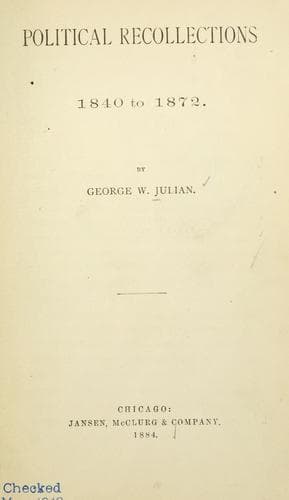
Political Recollections: 1840 to 1872Julian, George Washington
History
Political Recollections: 1840 to 1872
Julian, George Washington
Republican Party (U.S. : 1854- ) -- History; United States -- Politics and government
During this month I called with the Indiana delegation to see the
President respecting the appointment of Judge Otto, of Indiana, as
Assistant Secretary of the Interior. He was afterward appointed,
but Mr. Lincoln then only responded to our application by treating
us to four anecdotes. Senator Lane told me that when the President
heard a story that pleased him he took a memorandum of it and filed
it away among his papers. This was probably true. At any rate,
by some method or other, his supply seemed inexhaustible, and always
aptly available. Early in February General Burnside came before
the War Committee, and gave the most startling testimony as to the
demoralization of the Army of the Potomac, the bickerings and
jealousies of the commanding generals, and the vexations of the
President in dealing with the situation. On the 18th of March I
called on Mr. Lincoln respecting the appointments I had recommended
under the conscription law, and took occasion to refer to the
failure of General Fremont to obtain a command. He said he did
not know where to place him, and that it reminded him of the old
man who advised his son to take a wife, to which the young man
responded, "Whose wife should I take?" The President proceeded to
point out the practical difficulties in the way by referring to a
number of important commands which might suit Fremont, but which
could only be reached by removals he did not wish to make. I
remarked that I was very sorry if this was true, and that it was
unfortunate for our cause, as I believed his restoration to duty
would stir the country as no other appointment could. He said,
"it would stir the country on one side, and stir it the other way
on the other. It would please Fremont's friends, and displease
the conservatives; and that is all I can see in the _stirring_
argument." "My proclamation," he added, "was to stir the country;
but it has done about as much harm as good." These observations
were characteristic, and showed how reluctant he was to turn away
from the conservative counsels he had so long heeded.
On the 3d day of April the final report of the Committee on the
Conduct of the War was completed, and the portion of it relating
to the Army of the Potomac was in the hands of the Associated Press,
and awaited by the public with a curiosity which it is not easy
now to realize. The formation of the committee, as already stated,
grew out of the popular demand for a more vigorous war policy, and
its action was thus exposed to the danger of hasty conclusions;
but the press and public opinion of the loyal States, with remarkable
unanimity, credited it with great usefulness to the country, through
its labors to rescue the control of the war from incompetent and
unworthy hands.
Public-domain text, read in full here on John Shaqi.
Reviews
Reviews
No reviews yet
Be the first to share your thoughts on this work.
Elsewhere in the archive
Join the Discussion
Join the discussion
Sign in to leave a comment or review.
Sign InorCreate an account