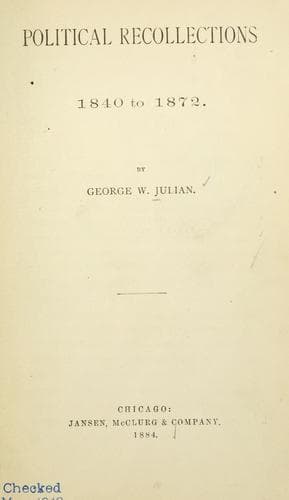
Political Recollections: 1840 to 1872Julian, George Washington
History
Political Recollections: 1840 to 1872
Julian, George Washington
Republican Party (U.S. : 1854- ) -- History; United States -- Politics and government
As the question of reconstruction became more and more engrossing,
the signs of a breach between the President and Congress revealed
themselves. He had disappointed the hopes of his radical friends,
and begun to show his partiality for conservative and Democratic
ideas. His estrangement from his party probably had its genesis
in the unfortunate exhibition of himself at the inauguration of
Mr. Lincoln, and the condemnation of it by leading Republicans,
which he could not forget. Instead of keeping his promise to be
the "Moses" of the colored people he turned his back upon them in
a very offensive public speech. His veto of the Freedmen's Bureau
bill finally stripped him of all disguises, and placed him squarely
against Congress and the people, while the House met his defiance
by a concurrent resolution emphatically condemning his reconstruction
policy, and thus opening the way for the coming struggle between
Executive usurpation and the power of Congress. His maudlin speech
on the 22d of February to the political mob which called on him,
branding as traitors the leaders of the party which had elected
him, completely dishonored him in the opinion of all Republicans,
and awakened general alarm. Everybody could now see the mistake
of his nomination at Baltimore, and that he was simply a narrow-
minded dogmatist and a bull-dog in disposition, who would do
anything in his power to thwart the wishes of his former friends.
During the month of March of this year, at the request of intelligent
working men in the employ of the Government, I introduced a bill
making eight hours a day's work in the navy yards of the United
States. This was the beginning of the eight hour agitation in
Congress. I had not given much thought to the necessity for such
legislation in this country, but the proposed measure seemed to me
an augury of good to the working classes, as the Ten Hour movement
had proved itself to be twenty years before. It could plead the
time laws of England as a precedent, enacted to protect humanity
against the "Lords of the Loom." These laws recognized labor as
capital endowed with human needs, and entitled to the special
guardianship of the State, and not as merchandise merely, to be
governed solely by the law of supply and demand. While I was a
believer in Free Trade, I was not willing to follow its logic in
all cases of conflict between capital and labor. My warfare against
chattel slavery and the monopoly of the soil had assumed the duty
of the Government to secure fair play and equal opportunities to
the laboring masses, and I was willing to embody that idea in a
specific legislative proposition, and thus invite its discussion
and the settlement of it upon its merits.
Public-domain text, read in full here on John Shaqi.
Reviews
Reviews
No reviews yet
Be the first to share your thoughts on this work.
Elsewhere in the archive
Join the Discussion
Join the discussion
Sign in to leave a comment or review.
Sign InorCreate an account