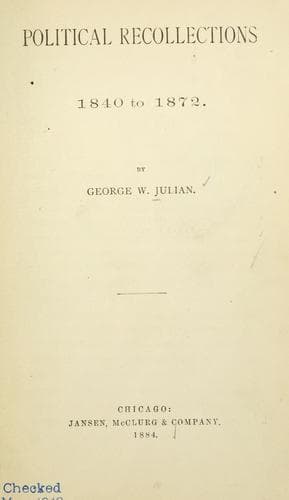
Political Recollections: 1840 to 1872Julian, George Washington
History
Political Recollections: 1840 to 1872
Julian, George Washington
Republican Party (U.S. : 1854- ) -- History; United States -- Politics and government
CHAPTER II.
THE CAMPAIGN OF 1844--ANNEXATION AND SLAVERY.
The nomination of Clay--His position on the slavery question and
annexation--Van Buren's letter to Hammet, and its effect upon the
South--His repudiation, and the nomination of Polk--The surprise
of the country--Unbounded confidence of the Whigs--The course of
the New York Democrats--The "Kane Letter"--Trouble among the Whigs
on the annexation question--Fierceness of the contest, and singular
ability of the leaders--The effect of Clay's defeat upon the Whigs
--Causes of the defeat--The Abolitionists, and the abuse heaped
upon them--Cassius M. Clay--Mr. Hoar's mission to South Carolina--
Election of John P. Hale--Annexation and war with Mexico--Polk's
message, and the Wilmot proviso--The Oregon question, and Alex. H.
Stephens.
The times were serious. The fun and frolic of 1840 had borne no
fruit, and that part of our history could not be repeated. The
campaign of 1844 promised to be a struggle for principle; and among
the Whigs all eyes were turned for a standard-bearer to Mr. Clay,
who had been so shabbily treated four years before. He was
unanimously nominated on the first of May, with Theodore Frelinghuysen
as the candidate for Vice President. The party issues were not
very sharply defined, but this was scarcely necessary with a
candidate who was proverbially regarded as himself "the embodiment
of Whig principles." On the subject of annexation, he clearly
defined his position in his letter of the 17th of April to the
"National Intelligencer." He declared that annexation and war with
Mexico were identical, and placed himself squarely against it,
except upon conditions specified, which would make the project of
immediate annexation impossible. On the slavery question, he had
not yet seriously offended the anti-slavery element in his own
party, and was even trusted by some of the voting anti-slavery men.
In a speech at Raleigh, in April of this year, he declared it to
be "the duty of each State to sustain its own domestic institutions."
He had publicly said that the General Government had nothing to do
with slavery, save in the matters of taxation, representation, and
the return of fugitive slaves. He had condemned the censure of
Mr. Giddings in 1842 as an outrage, and indorsed the principles
laid down in his tract, signed "Pacificus," on the relations of
the Federal Government to slavery, and the rights and duties of
the people of the free States. In his earlier years, he had been
an outspoken emancipationist, and had always frankly expressed his
opinion that slavery was a great evil. These considerations, and
especially his unequivocal utterances against the annexation scheme,
were regarded as hopeful auguries of a thoroughly united party,
and its triumph at the polls; while Mr. Webster, always on the
presidential anxious-seat, and carefully watching the signs of the
political zodiac, now cordially lent his efforts to the Whig cause.
Public-domain text, read in full here on John Shaqi.
Reviews
Reviews
No reviews yet
Be the first to share your thoughts on this work.
Join the Discussion
Join the discussion
Sign in to leave a comment or review.
Sign InorCreate an account