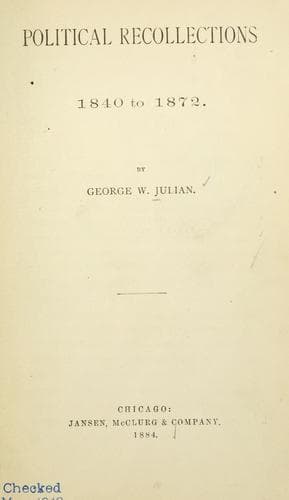
Political Recollections: 1840 to 1872Julian, George Washington
History
Political Recollections: 1840 to 1872
Julian, George Washington
Republican Party (U.S. : 1854- ) -- History; United States -- Politics and government
This was pre-eminently true in Indiana, and especially so as to
myself. The leaders of Grant, borrowing the spirit of the campaign,
set all the canons of decency at defiance. "Sore head," "Renegade,"
"Apostate," "Rebel," and "deadbeat," were the compliments constantly
lavished. Garbled extracts from my old war speeches were plentifully
scattered over the State, as if we had been still in the midst of
the bloody conflict, and I had suddenly betrayed the country to
its enemies. Garbled and forged letters were peddled and paraded
over the State by windy political blatherskites, who were hired to
propagate the calumnies of their employers. In fact, my previous
political experience supplied no precedent for this warfare of my
former Republican friends. But I was not unprepared for it, and
fully availed myself of the right of self-defense and counter
attack. I would not make myself a blackguard, but I met my assailants
in every encounter with the weapons of argument and invective, and
stretched them on the rack of my ridicule; while their prolonged
howl bore witness to the effectiveness of my work. My whole heart
was in it. The fervor and enthusiasm of earlier years came back
to me, and a kindred courage and faith armed me with the strength
which the work of the canvass demanded.
The novelty of the canvass was indeed remarkable in all respects.
The Liberal Republicans had not changed any of their political
opinions, nor deserted any principle they had ever espoused, touching
the questions of slavery and the war; and yet they were now in the
fiercest antagonism with the men who had been politically associated
with them ever since the organization of the party, and who had
trusted and honored them through all the struggles of the past.
They were branded as "Apostates" from their anti-slavery faith;
but slavery had perished forever, and every man of them would have
been found fighting it as before, if it had been practicable to
call it back to life; while many of their assailants had distinguished
themselves by mobbing Abolitionism in the day of its weakness.
How could men apostatize from a cause which they had served with
unflinching fidelity until it was completely triumphant? And how
was it possible to fall from political grace by withdrawing from
the fellowship of the knaves and traders that formed the body-guard
of the President, and were using the Republican party as the
instrument of wholesale schemes of jobbery and pelf? To charge
the Liberal Republicans with apostasy because they had the moral
courage to disown and denounce these men was to invent a definition
of the term which would have made all the great apostates of history
"honorable men."
Public-domain text, read in full here on John Shaqi.
Reviews
Reviews
No reviews yet
Be the first to share your thoughts on this work.
Elsewhere in the archive
Join the Discussion
Join the discussion
Sign in to leave a comment or review.
Sign InorCreate an account