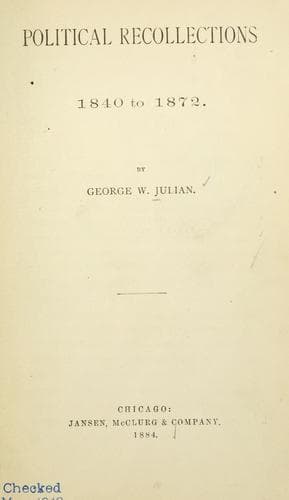
Political Recollections: 1840 to 1872Julian, George Washington
History
Political Recollections: 1840 to 1872
Julian, George Washington
Republican Party (U.S. : 1854- ) -- History; United States -- Politics and government
They were called "Rebels"; but the war had been over seven years
and a half, and if the clock of our politics could have been set
back and the bloody conflict re-instated, every Liberal would have
been shouting, as before, for its vigorous prosecution. No man
doubted this who was capable of taking care of himself without the
help of a guardian.
It was charged that "they changed sides" in politics; but the sides
themselves had been changed by events, and the substitution of new
issues for the old, and nobody could deny this who was not besotted
by party devil-worship or the density of his political ignorance.
They were called "sore-heads" and "disappointed place-hunters;"
but the Liberal leaders, in rebelling against their party in the
noon-day of its power, and when honors were within their grasp,
were obliged to "put away ambition" and taste political death, and
thus courageously illustrate the truth that "the duties of life
are more than life." The charge was as glaringly stupid as it was
flagrantly false.
But the novelty of this canvass was equally manifest in the political
fellowships it necessitated. While facing the savage warfare of
their former friends Liberal Republicans were suddenly brought into
the most friendly and intimate relations with the men whose recreancy
to humanity they had unsparingly denounced for years. They were
now working with these men because the subjects on which they had
been divided were withdrawn, and the country had entered upon a
new dispensation. The mollifying influence of peace, aided, no
doubt, by the organized roguery which in the name of Republicanism
held the Nation by the throat, unveiled to Liberals a new political
horizon, and they gladly exchanged the key-note of hate and war
for that of fraternity and reunion. They saw that the spirit of
wrath which had so moved the Northern States during the conflict
was no longer in order. The more they pondered the policy of
amnesty and followed up the work of the canvass the more thoroughly
they became reconstructed in heart. They discovered that the men
whom they had been denouncing with such hot indignation for so many
years were, after all, very much like other people. Personally
and socially they seemed quite as kindly and as estimable as the
men on the other side, while very many of them had undoubtedly
espoused the cause of slavery under a mistaken view of their
constitutional obligations, and as a phase of patriotism, while
sincerely condemning it on principle. Besides, Democrats had done
a very large and indispensable work in the war for the Union, and
they now stood upon common ground with the Republicans touching
the questions on which they had differed. On these questions the
party platforms were identical. If their position was accepted as
a necessity and not from choice, they were only a little behind
the Republicans, who, as a party, only espoused the cause of the
negro under the whip and spur of military necessity, and not the
Public-domain text, read in full here on John Shaqi.
Reviews
Reviews
No reviews yet
Be the first to share your thoughts on this work.
Elsewhere in the archive
Join the Discussion
Join the discussion
Sign in to leave a comment or review.
Sign InorCreate an account