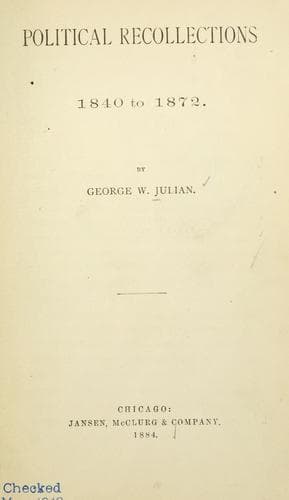
Political Recollections: 1840 to 1872Julian, George Washington
History
Political Recollections: 1840 to 1872
Julian, George Washington
Republican Party (U.S. : 1854- ) -- History; United States -- Politics and government
In this state of the country, and of the old parties, a new
organization and another nomination became inevitable. The followers
of Mr. Van Buren, in New York and other States, were aching for
the opportunity to make themselves felt in avenging the wrong done
to their chief in 1844, and were quite ready to strike hands with
the members of the Liberty party. The members of that party were
generally ready to withdraw their candidate for President and unite
with the anti-slavery Whigs and Democrats of the Northern States,
if an honorable basis of action could be agreed upon. The "Conscience
Whigs" of Massachusetts, and thousands of Whigs in other States,
who regarded the freedom of our Territories as a vital issue, and
were thoroughly soured by the nomination of General Taylor, were
equally anxious to fuse with the other elements of political
discontent, and make their voices heard in a new and independent
organization. There was little time for delay, and as soon as the
troubled political elements would permit, a call was issued for a
National Free Soil Convention, at Buffalo, on the 9th of August.
The Convention was historic. It marked a new and significant
departure in party politics, and was a conspicuous milestone in
the anti-slavery journey. It met in a spacious pavilion, and was
one of the largest political gatherings ever assembled in the
country, and animated by unbounded earnestness and enthusiasm.
Its leading spirits were men of character and undisputed ability.
The "Barnburners" of New York were largely in attendance, including
such veteran leaders as Preston King, Benjamin F. Butler, David
Dudley Field, Samuel J. Tilden, and James W. Nye. Ohio sent a
formidable force headed by Joshua R. Giddings, Salmon Chase, and
Samuel Lewis. The "Conscience Whigs" of Massachusetts were well
represented, with Charles Francis Adams, Stephen C. Phillips, and
Francis W. Bird, in the front. The Liberty party sent its delegates,
including such men as the Rev. Joshua Leavitt, Samuel Lewis, and
Henry B. Stanton. The disappointed Clay Whigs were there, led by
such representative men as Joseph L. White, who were eager to lay
hold of any weapon by which they could hope to strike down the
betrayers of the Whig cause. The "Land Reformers" and "Workingmen"
of New York were represented, as also the special advocates of
"Cheap postage for the people," who longed to be rid of the tariff
of twenty-five cents on the privilege of sending a single letter
through the mails, and whose wishes afterward found expression in
the platform.
Public-domain text, read in full here on John Shaqi.
Reviews
Reviews
No reviews yet
Be the first to share your thoughts on this work.
Join the Discussion
Join the discussion
Sign in to leave a comment or review.
Sign InorCreate an account