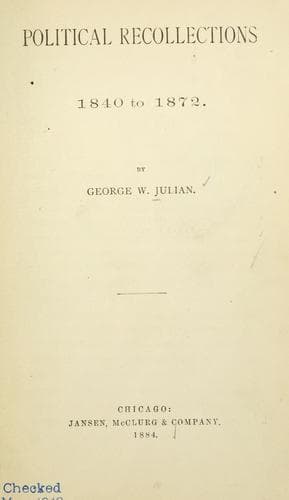
Political Recollections: 1840 to 1872Julian, George Washington
History
Political Recollections: 1840 to 1872
Julian, George Washington
Republican Party (U.S. : 1854- ) -- History; United States -- Politics and government
This strife was aggravated by its peculiar relations to the dominant
political parties. The sacrifice of Martin Van Buren in 1844,
because of his manly letter on the annexation of Texas, had been
a sore trial to his devoted friends. They could neither forgive
nor forget it; and when the opportunity for revenge finally came
in 1848, they laid hold of it with the sincerest and most heartfelt
satisfaction. As we have seen, they bolted from their party, threw
themselves into the Free Soil movement, and thus made the defeat
of Gen. Cass inevitable by the election of Gen. Taylor. Thousands
of these bolting Democrats, particularly in the State of New York,
cared more for the personal and political fortunes of Mr. Van Buren
than for the slavery question, as their subsequent return to their
party allegiance made manifest; but their action was none the less
decisive in the emergency which called it forth. The trouble in
the Whig camp was also serious. The last hopes of Mr. Clay and
his worshipers had perished forever in the nomination of the hero
of the Mexican war and the owner of two hundred slaves, by a
Convention which became famous as "the slaughter house of Whig
principles." Very many of these Clay Whigs, like the devotees of
Mr. Van Buren, would have been satisfied with almost any dispensation
of the slavery issue if their chief had been nominated, but they
were now enlisted in the anti-slavery army, and, like Joseph L.
White, of Indiana, vociferously shouted for "liberty and revenge."
Mr. Webster and his friends were also profoundly disgusted, and
lent a strong hand to the work of party insubordination, while the
election of Gen. Taylor was quite naturally followed by formidable
party coalitions. One of these, as already stated, made Salmon P.
Chase a senator of the United States from Ohio, as John P. Hale
had been chosen from New Hampshire some time before, and Charles
Sumner came in a little later from Massachusetts; and the House of
Representatives now contained nine distinctly anti-slavery men,
chosen from different States by kindred combinations, who had
completely renounced their allegiance to the old parties, and were
able to wield the balance of power in that body. Such were the
complications of the great problem which confronted the Thirty-
first Congress at the opening of its first session, on the third
day of December, 1849.
Public-domain text, read in full here on John Shaqi.
Reviews
Reviews
No reviews yet
Be the first to share your thoughts on this work.
Join the Discussion
Join the discussion
Sign in to leave a comment or review.
Sign InorCreate an account