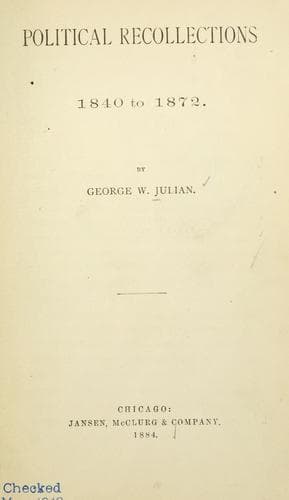
Political Recollections: 1840 to 1872Julian, George Washington
History
Political Recollections: 1840 to 1872
Julian, George Washington
Republican Party (U.S. : 1854- ) -- History; United States -- Politics and government
and doubtful recovery had awakened a peculiar interest in my fortunes
at that time, on account of the political situation, and the possible
significance of a single vote. John P. Hale happened to enter the
hall during these congratulations, and still further lighted up
the scene by his jolly presence; while Dr. Bailey, of the "National
Era," also joined in the general welcome, and at once confirmed
all the good opinions I had formed of this courageous and single-
minded friend of the slave. I was delighted with all my brethren,
and at once entered fully into their plans and counsels.
An incident connected with the organization of the House, which
caused intense excitement at the time, seems to deserve some notice.
It occurred on the 12th of December, while William J. Brown, of
Indiana, was being voted for as the Democratic candidate for Speaker.
He was a pro-slavery Democrat, through and through, and commanded
the entire and unhesitating confidence of Southern members; and
yet, on the last ballot for him, he received the votes of Allen,
Durkee, Giddings, King, and Wilmot, and came within two votes of
an election. The support of Mr. Brown by the leading Free Soilers
was a great surprise to both sides of the House, and the suspicion
that some secret arrangement had been made gave birth to a rumor
to that effect. After the balloting, while Mr. Bailey, of Virginia,
was on the floor, Mr. Ashmun, of Massachusetts, asked him whether
a secret correspondence had not taken place between some member of
the Free Soil party and Mr. Brown, by which the latter had agreed
to constitute the Committees on the Judiciary, on Territories, and
on the District of Columbia, in a manner satisfactory to that party.
Mr. Bailey scouted the idea, and asked Mr. Ashmun what authority
he had for the statement. Mr. Ashmun replied, "Common rumor"; to
which Mr. Bailey rejoined, "Does not the gentleman know that common
rumor is a common liar?" Turning to Mr. Brown, he said, "Has any
such correspondence taken place?" Mr. Brown shook his head, and
Mr. Bailey became more emphatic than ever in his denial. But the
fever was now up, and the Southern members scented treason. Several
of them withheld their votes from Mr. Brown because of his Free
Soil support, and thus prevented his election. He was in a very
trying dilemma with his Southern friends, while the Free Soilers
who had supported him were also placed in a novel predicament, and
subjected to catechism. The fact was finally revealed in the course
of a long and exciting debate, that Mr. Wilmot _had_ entered into
a correspondence with Mr. Brown on the subject of the organization
of the Committees named, and that the latter _had_ promised in
writing to constitute them as stated in Mr. Ashumn's inquiry--
declaring that he had "always been opposed to the extension of
slavery," and believed that "the Federal Government should be
relieved from the responsibility of slavery where it had the
Public-domain text, read in full here on John Shaqi.
Reviews
Reviews
No reviews yet
Be the first to share your thoughts on this work.
Join the Discussion
Join the discussion
Sign in to leave a comment or review.
Sign InorCreate an account