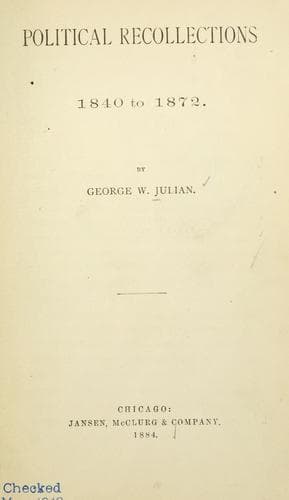
Political Recollections: 1840 to 1872Julian, George Washington
History
Political Recollections: 1840 to 1872
Julian, George Washington
Republican Party (U.S. : 1854- ) -- History; United States -- Politics and government
In the meantime the slavery question had been receiving daily
attention. The strife over the Speakership had necessarily involved
it, and constantly provoked its animated discussion. The great
issue was the Congressional prohibition of slavery in the Territories,
then popularly known as the "Wilmot proviso"; and the first vote
on it was taken December 31st, upon the motion to lay on the table
Mr. Root's resolution which embodied it. The yeas were 83, nays
101; being a majority of only 18 in its favor. The Southern men
seemed to gather hope and courage from this vote. On January 4th,
the President sent in his special message relative to California
and New Mexico, announcing his famous "Non-action" policy, which
was simply another name for the "Non-intervention" dogma of Gen.
Cass. A year before he had declared that the new Territories must
not be "surrendered to the pistol and the bowie-knife"; but a new
light now dawned upon him, and he advised Congress to leave the
Territories to themselves till their people should be prepared to
ask admission into the Union as States. He talked glibly about
"geographical parties" and the "operation of natural causes" as
any trained Whig politician, and seemed to have totally forgotten
his repeated pledges not to interfere with the action of Congress
respecting "domestic questions." While the hand of the Executive
was thus at work, extreme men in both Houses led the way in violent
and inflammatory speeches. "When we ask for justice, and to be
let alone," said Mr. Clingman, of North Carolina, "we are met by
the senseless and insane cry of Union, Union! Sir, I am disgusted
with it. When it comes from Northern gentlemen who are attacking
us, it falls on my ear as it would do if a band of robbers had
surrounded a dwelling, and when the inmates attempted to resist,
the assailants should raise the cry of peace, union, harmony!" He
gave out the threat, that unless the slave-holders were allowed to
extend their system over the virgin soil of our Territories, they
would block the wheels of Government, and involve the nation in
the horrors of civil war. He charged that the free States "keep
up and foster in the bosoms Abolition Societies, whose main purpose
is to scatter fire-brands throughout the South, to incite servile
insurrections, and stimulate by licentious pictures our negroes to
invade the persons of our white women." Mr. Brown, of Mississippi,
said he regarded slavery "as a great moral, social and _religious_
blessing,--a blessing to the slave, and a blessing to the master."
He graciously admitted that Northern people thought slavery an
evil; but he added, "Very well, think so; _but keep your thoughts
to yourselves_." Jefferson Davis, then as ever afterward, the
apostle of disunion, declared that "slavery existed in the tents
of the patriarchs, and in the households of His own chosen people";
that "it was established by the decree of Almighty God," and
Public-domain text, read in full here on John Shaqi.
Reviews
Reviews
No reviews yet
Be the first to share your thoughts on this work.
Join the Discussion
Join the discussion
Sign in to leave a comment or review.
Sign InorCreate an account