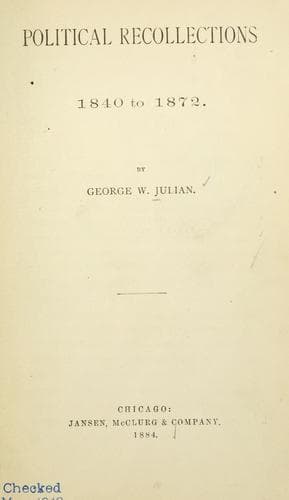
Political Recollections: 1840 to 1872Julian, George Washington
History
Political Recollections: 1840 to 1872
Julian, George Washington
Republican Party (U.S. : 1854- ) -- History; United States -- Politics and government
Indeed, the outlook as to the formation of a triumphant anti-slavery
party was not so promising towards the close of the year 1855 as
it had seemed in the spring of the preceding year. If the Free
Soilers had been clear-sighted enough to distinguish between that
which was transient and that which was permanent in the forces
which had roused the people of the free States, and, availing
themselves of the repeal of the Missouri restriction as a God-send
to their cause, had summoned the manhood of the country to their
help, a powerful impulse would have been given in the right direction.
But in the general confusion and bewilderment of the times many of
them lost their way, and were found mustering with the mongrel
hordes of Know-Nothingism, and under captains who were utterly
unworthy to lead them. Instead of inflexibly maintaining their
ground and beckoning the people to come up and possess it, they
meanly deserted it themselves, while vainly expecting others to
occupy it. The Whigs were totally powerless to render any service
without first disbanding their party, and this, in many localities,
they declined to do. Both wings of the Know-Nothing movement were
organized obstacles to the formation of a new party, while the
bolters from the Democrats were as unprepared for radical anti-
slavery work as the Whigs or Know-Nothings. But notwithstanding
all these drawbacks, real progress had been made. In the Thirty-
fourth Congress, Wilson, Foster, Harlan, Trumbull, and Durkee were
chosen senators. In the House were Burlingame, Buffington, Banks,
Hickman, Grow, Covode, Sherman, Bliss, Galloway, Bingham, Harlan,
Stanton, Colfax, Washburn, and many others. These were great gains,
and clearly pointed to still larger accessions, and the final
subordination of minor issues to the grand one on which the people
of the free States were to take their stand. An unprecedented
struggle for the Speakership began with the opening of the Thirty-
fourth Congress, and lasted till the second day of February, when
the free States finally achieved their first victory in the election
of Banks. Northern manhood at last was at a premium, and this was
largely the fruit of the "border ruffian" attempts to make Kansas
a slave State, which had stirred the blood of the people during
the year 1855. In the meantime, the arbitrary enforcement of the
Fugitive Slave Act still further contributed to the growth of an
anti-slavery opinion. The famous case of Anthony Burns in Boston,
the prosecution of S. M. Booth in Wisconsin, and the decision of
the Supreme Court of that State, the imprisonment of Passmore
Williamson in Philadelphia, and the outrageous rulings of Judge
Kane, and the case of Margaret Garner in Ohio, all played their
part in preparing the people of the free States for organized
political action against the aggressions of slavery.
Public-domain text, read in full here on John Shaqi.
Reviews
Reviews
No reviews yet
Be the first to share your thoughts on this work.
Elsewhere in the archive
Join the Discussion
Join the discussion
Sign in to leave a comment or review.
Sign InorCreate an account