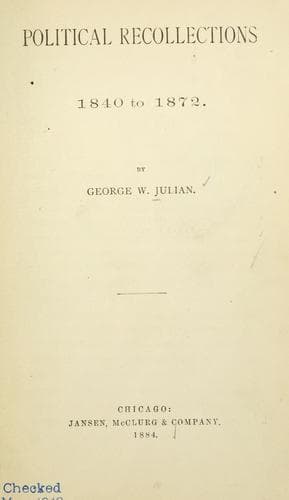
Political Recollections: 1840 to 1872Julian, George Washington
History
Political Recollections: 1840 to 1872
Julian, George Washington
Republican Party (U.S. : 1854- ) -- History; United States -- Politics and government
Near the close of the year 1855, the chairmen of the Republican
State Committees of Ohio, Massachusetts, Pennsylvania, Vermont,
and Wisconsin, issued a call for a National Republican Convention
to be held at Pittsburg, on the 22d of February, 1856, for the
purpose of organizing a National Republican party, and making
provision for a subsequent convention to nominate candidates for
President and Vice President. It was very largely attended, and
bore witness to the spirit and courage which the desperate measures
of the slave oligarchy had awakened throughout the Northern States.
All the free States were represented, and eight of the slave-holding,
namely: Maryland, Virginia, Delaware, Kentucky, Missouri, Tennessee,
North Carolina, and Texas. The convention assembled in Lafayette
Hall, and the Hon. John A. King, of New York, a son of Rufus King,
was made temporary chairman, and Francis P. Blair, of Maryland,
the intimate friend of President Jackson, was made its permanent
president. He was most enthusiastically greeted on taking the
chair, and began his address with the remark that this was the
first time he had ever been called on to make a speech. His views
were too conservative in tone to satisfy the demands of the crisis,
but he was most cordially welcomed as a distinguished delegate from
a slave State. The convention was opened by a prayer from Owen
Lovejoy, and there was a suppressed murmur of applause when he
asked God to enlighten the mind of the President of the United
States, and turn him from his evil ways, and if this was not
possible, to take him away, so that an honest and God-fearing man
might fill his place. Horace Greeley was seen in the audience,
and was loudly and unitedly called on for a speech. He spoke
briefly, saying that he had been in Washington several weeks, and
friends there "counseled extreme caution in our movements." This
was the burden of his exhortation. At the close of his remarks
Mr. Giddings was tumultuously called for, and responded by saying
that Washington was the last place in the world to look for counsel
or redress, and related an anecdote of two pious brothers, named
Joseph and John, who in early times had begun a settlement in the
West. Joseph prayed to the Lord: "O, Lord! we have begun a good
work; we pray thee to carry it on thus,"--giving specific directions.
But John prayed: "O, Lord, we have begun a good work; carry it on
as you think best, and don't mind what Joe says." Mr. Giddings
then introduced the Rev. Owen Lovejoy, of Illinois,--"not Joe, but
John." Mr. Lovejoy delighted the audience, and was followed by
Preston King and other speakers; and it was quite manifest that
this was a _Republican_ convention, and not a mere aggregation of
Whigs, Know-Nothings, and dissatisfied Democrats. It contained a
considerable Know-Nothing element, but it made no attempt at
leadership, while Charles Remelin and other speakers were
Public-domain text, read in full here on John Shaqi.
Reviews
Reviews
No reviews yet
Be the first to share your thoughts on this work.
Elsewhere in the archive
Join the Discussion
Join the discussion
Sign in to leave a comment or review.
Sign InorCreate an account