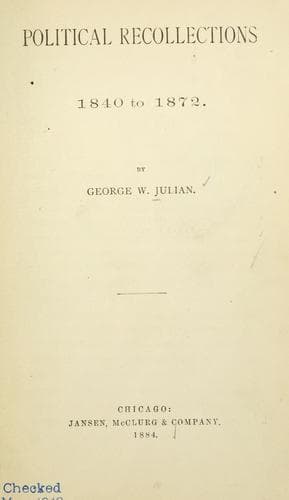
Political Recollections: 1840 to 1872Julian, George Washington
History
Political Recollections: 1840 to 1872
Julian, George Washington
Republican Party (U.S. : 1854- ) -- History; United States -- Politics and government
The Democratic National Convention met at Cincinnati on the second
of June. The candidates were Buchanan, Pierce, and Douglas. On
the seventeenth ballot Buchanan was unanimously nominated for
President, and on the second ballot John C. Breckenridge was
nominated for Vice President. The platform re-affirmed the action
of Congress respecting the repeal of the Missouri compromise and
the compromises of 1850, and recognized the right of the people of
all the Territories, including Kansas and Nebraska, whenever the
number of their inhabitants justified it, to form a Constitution
with or without domestic slavery, and to be admitted into the Union
upon terms of equality with the other States. These declarations,
together with the express denial to Congress of the right to
interfere with slavery in the Territories, were accepted as
satisfactory to the South, and were fairly interpreted to mean that
the people of the Territories, pending their territorial condition,
had no power to exclude slavery therefrom. In Mr. Buchanan's letter
of acceptance, he completely buried his personality in the platform,
and Albert G. Brown of Mississippi, and Governor Wise of Virginia,
pronounced him as true to the South as Mr. Calhoun himself. These
were the tickets for 1856, but the real contest was between Buchanan
and Fremont. It was pre-eminently a conflict of principles. The
issues could hardly have been better defined, and they were vital.
It was a struggle between two civilizations, between reason and
brute force, between the principles of Democracy and the creed of
Absolutism; and the case was argued with a force, earnestness, and
fervor, never before known. No Presidential contest had ever so
touched the popular heart, or so lifted up and ennobled the people
by the contagion of a great and pervading moral enthusiasm. The
campaign for Buchanan, however, was not particularly animated, at
least in the Northern States. It illustrated the power of party
machinery, and the desperate purpose to press forward along a path
which had been followed too far to call a halt. It was a struggle
for party ascendancy by continual and most humiliating concessions
to the ever-multiplying demands of slavery; and the ardor of the
struggle must have been cooled by many troublesome misgivings as
to the final effect of these concessions, and the policy of purchasing
a victory at such a price.
Public-domain text, read in full here on John Shaqi.
Reviews
Reviews
No reviews yet
Be the first to share your thoughts on this work.
Elsewhere in the archive
Join the Discussion
Join the discussion
Sign in to leave a comment or review.
Sign InorCreate an account