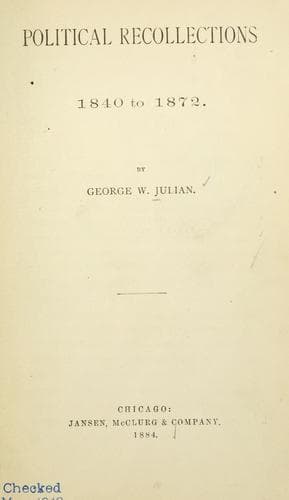
Political Recollections: 1840 to 1872Julian, George Washington
History
Political Recollections: 1840 to 1872
Julian, George Washington
Republican Party (U.S. : 1854- ) -- History; United States -- Politics and government
enthusiastically applauded when they denounced Know-Nothingism as
a mischievous side issue in our politics, which the new movement
should openly repudiate. The convention was in session two days,
and was singularly harmonious throughout. Its resolutions and
address to the people did not fitly echo the feeling and purpose
of its members, but this was a preliminary movement, and it was
evident that nothing could stay the progress of the cause. As
chairman of the committee on organization, I had the honor to report
the plan of action through which the new party took life, providing
for the appointment of a National Executive Committee, the holding
of a National Convention in Philadelphia on the 17th of June, for
the nomination of candidates for President and Vice President, and
the organization of the party in counties and districts throughout
the States.
The Philadelphia convention was very large, and marked by unbounded
enthusiasm. The spirit of liberty was up, and side issues forgotten.
If Know-Nothingism was present, it prudently accepted an attitude
of subordination. The platform reasserted the self-evident truths
of the Declaration of Independence, and denied that Congress, the
people of a Territory, or any other authority, could give legal
existence to slavery in any Territory of the United States. It
asserted the sovereign power of Congress over the Territories, and
its right and duty to prohibit it therein. Know-Nothingism received
no recognition, and the double-faced issue of the restoration of
the Missouri compromise was disowned, while the freedom of Kansas
was dealt with as a mere incident of the conflict between liberty
and slavery. On this broad platform John C. Fremont was nominated
for President on the first ballot, and Wm. L. Dayton was unanimously
nominated for Vice-President. The National Republican party was
thus splendidly launched, and nothing seemed to stand in the way
of its triumph but the mischievous action of the Know-Nothing party,
and a surviving faction of pro-slavery Whigs. The former party
met in National Convention in Philadelphia, on the twenty-second
of February, and nominated Millard Fillmore for President and Andrew
J. Donelson for Vice President. Some bolters from this convention
subsequently nominated Nathaniel P. Banks and William F. Johnson
as their candidates, and a remnant of the Whig party held a convention
at Baltimore on the seventeenth of September, and endorsed Fillmore
and Donelson; but a dissatisfied portion of the convention afterward
nominated Commodore Stockton and Kenneth Raynor. All these factions
were destined soon to political extinction, but in a hand-to-hand
fight with the slave power they yet formed a considerable obstacle
to that union and harmony in the free States which were necessary
to success.
Public-domain text, read in full here on John Shaqi.
Reviews
Reviews
No reviews yet
Be the first to share your thoughts on this work.
Elsewhere in the archive
Join the Discussion
Join the discussion
Sign in to leave a comment or review.
Sign InorCreate an account