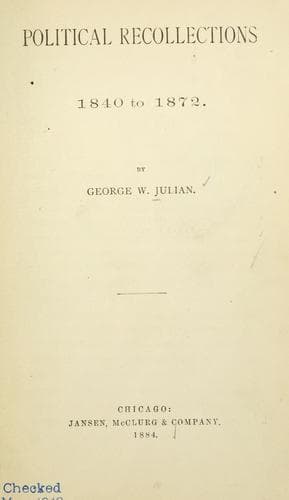
Political Recollections: 1840 to 1872Julian, George Washington
History
Political Recollections: 1840 to 1872
Julian, George Washington
Republican Party (U.S. : 1854- ) -- History; United States -- Politics and government
The steady march of the Republican party toward ascendancy was
shown in the Thirty-sixth Congress, which met in December, 1859.
There were now twenty-four Republican senators, and one hundred
and nine representatives. Early in the first session of this
Congress an interesting debate occurred in the Senate on a proposition
to provide for the education of the colored children of the District
of Columbia. Mr. Mason condemned the proposition, and said it was
wise to prohibit the education of the colored race. Jefferson
Davis declared that the Government was not made for them, and that
"we have no right to tax our people to educate the barbarians of
Africa." These and kindred utterances were very well calculated
to aid the work of anti-slavery progress. John Brown's raid into
Virginia kindled the ire of the slave-holders to a degree as yet
unprecedented, and although his act found few defenders in the
Northern States, the heroism with which he met his fate, the pithy
correspondence between Gov. Wise and Mrs. Child, the language of
Southern senators in dealing with the subject, and the efforts made
to ferret out Brown's associates, all tended to strengthen the
growing hostility to slavery and prepare the way for the final
conflict. The designs of the slaveholders upon Cuba, which were
avowed in this Congress, and their purpose to acquire it for the
extension of slavery, by purchase if they could, but if not by war,
served the same purpose. The growing demand for the revival of
the African slave trade, as shown by the avowals of leading men in
both houses of Congress, and their cold-blooded utterances on the
subject, produced a profound impression on the country, and called
forth the startling fact that the city of New York was then one of
the greatest slave-trading marts in the world, and that from thirty
to sixty thousand persons a year were taken from Africa to Cuba by
vessels from that single port. Such facts as these, and that the
laws of the Union for the suppression of the traffic were not only
a dead letter but that the slave masters and their allies sullenly
refused to take any steps whatever for the remedy of this organized
inhumanity, were capital arguments for the Republicans, which they
employed with telling effect. The refusal to admit Oregon as a
State without a constitutional provision excluding people of color,
the rejection of Kansas on her application with a Constitution
fairly adopted by her people, and the great speech of Sumner on
"The Barbarism of Slavery," which this last application called
forth, all served their purpose in the growth of anti-slavery
opinion. So did the attempt to divide California for the purpose
of introducing slavery into the southern portion; the veto of an
Act of the Territorial Legislature of Kansas abolishing slavery,
and of a similar act in Nebraska; the acts of several Southern
States permitting free colored persons to sell themselves as slaves
Public-domain text, read in full here on John Shaqi.
Reviews
Reviews
No reviews yet
Be the first to share your thoughts on this work.
Elsewhere in the archive
Join the Discussion
Join the discussion
Sign in to leave a comment or review.
Sign InorCreate an account