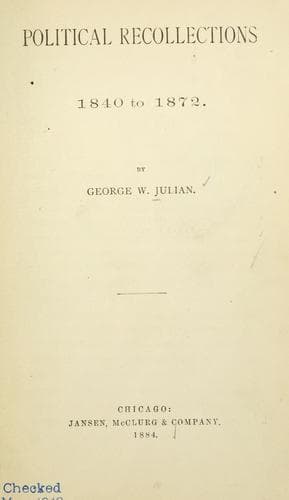
Political Recollections: 1840 to 1872Julian, George Washington
History
Political Recollections: 1840 to 1872
Julian, George Washington
Republican Party (U.S. : 1854- ) -- History; United States -- Politics and government
if they chose to do so in preference to expulsion from the land of
their birth and their homes; the decision of the courts of Virginia
that slaves had no social or civil rights, and no legal capacity
to choose between being emancipated or sold as slaves; the refusal
of the Government to give a passport to a colored physician of
Massachusetts, for the reason that such privileges were never
conferred upon persons of color; and the revolutionary sentiments
uttered by governors and legislatures of various Southern States,
some of which declared that the election of a Republican President
would be sufficient cause for withdrawal from the Union. That
these were important aids to the progress of freedom was shown by
the passage of laws in various Northern States for the protection
of personal liberty, forbidding the use of local jails for the
detention of persons claimed as fugitive slaves, and securing for
them the right of trial by jury and the benefit of the writ of
_habeas corpus_. This healthy reaction was still further shown in
wholesome judicial decisions in several Northern States affirming
the citizenship of negroes, and denying the right of transit of
slave-holders with their slaves over their soil.
The struggle for the Speakership in this Congress, which lasted
eight weeks, was also a first-rate training school for Republicanism.
Helper's famous book, "The Impending Crisis," had made a decided
sensation throughout the country, and John Sherman, the principal
candidate of the Republicans for Speaker, had endorsed it, though
he now denied the fact. Mr. Millson of Virginia, declared that
the man who "consciously, deliberately, and of purpose, lends his
name and influence to the propagation of such writings, is not only
not fit to be Speaker, but he is not fit to live." De Jarnette,
of the same State, said that Mr. Seward was "a perjured traitor,
whom no Southerner could consistently support or even obey, should
the nation elect him President." Mr. Pryor said that eight million
Southern freemen could not be subjugated by any combination whatever,
"least of all by a miscellaneous mob of crazy fanatics and conscience-
stricken traitors." Mr. Keitt said that "should the Republican
party succeed in the next Presidential election, my advice to the
South is to snap the cords of the Union at once and forever." Mr.
Crawford of Georgia said, "we will never submit to the inauguration
of a black Republican President"; and these and like utterances
were applauded by the galleries. The growing madness and desperation
in the Senate were equally noteworthy. This was shown by the
removal of Mr. Douglas from the chairmanship of the Committee on
Territories, and the determined purpose to read him out of the
party for refusing to violate the principle of popular sovereignty
in the Territory of Kansas. The attempt to hunt down a man who
had done the South such signal service in dragooning the Northern
Public-domain text, read in full here on John Shaqi.
Reviews
Reviews
No reviews yet
Be the first to share your thoughts on this work.
Elsewhere in the archive
Join the Discussion
Join the discussion
Sign in to leave a comment or review.
Sign InorCreate an account