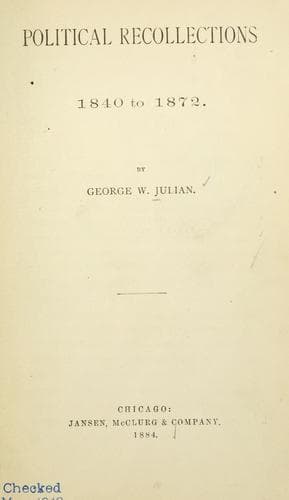
Political Recollections: 1840 to 1872Julian, George Washington
History
Political Recollections: 1840 to 1872
Julian, George Washington
Republican Party (U.S. : 1854- ) -- History; United States -- Politics and government
The Presidential Campaign of 1860 was a very singular commentary
on the Compromise measures of 1850 and the "finality" platforms of
1852. The sectional agitation which now stirred the country
outstripped all precedent, and completely demonstrated the folly
of all schemes of compromise. The Democratic National Convention
met in the city of Charleston on the twenty-third day of May. Its
action now seems astounding, although it was the inevitable result
of antecedent facts. The Democratic party had the control of every
department of the Government, and a formidable popular majority
behind it. It had the complete command of its own fortunes, and
there was no cause or even excuse for the division which threatened
its life. The difference between the Southern Democrats and the
followers of Douglas was purely metaphysical, eluding entirely the
practical common sense of the people. Both wings of the party now
stood committed to the Dred Scott decision, and that surrendered
everything which the extreme men of the South demanded. It was "a
quarrel about goats' wool," and yet the Southern Democrats were
maddened at the thought of submitting to the nomination of Douglas
for the Presidency. His sin in the Lecompton affair was counted
unpardonable, and they seemed to hate him even more intensely than
they hated the Abolitionists. A committee on resolutions was
appointed, which submitted majority and minority, or Douglas and
anti-Douglas, reports. These were hotly debated, but the Douglas
platform was adopted, which led to the secession of the Southern
delegates. On the fifty-seventh ballot Mr. Douglas received a
clear majority of the Electoral College, but the Convention then
adjourned till the eighteenth of June, in the hope that harmony
might in some way be restored. On reassembling this was found
impossible, and the balloting was resumed, which finally gave Mr.
Douglas all the votes cast but thirteen, and he was declared the
Democratic nominee. The Convention then nominated for the Vice
Presidency Herschel V. Johnson, of Georgia, a disciple of Calhoun,
whose extreme opinions were well known. He was unequivocally
committed to the doctrine that neither the General Government nor
a Territorial Government can impair the right of slave property in
the common Territories. This illustration of the political profligacy
of the Douglas managers, and burlesque upon popular sovereignty,
was as remarkable as the madness of the seceders in fighting him
for his supposed anti-slavery prejudices. The bolters from this
convention afterward nominated John C. Breckenridge as their
candidate for President and Joseph Lane for Vice President. The
Democratic canvass was thus inaugurated, and the overthrow of the
party provided for in the mere wantonness of political folly.
Public-domain text, read in full here on John Shaqi.
Reviews
Reviews
No reviews yet
Be the first to share your thoughts on this work.
Elsewhere in the archive
Join the Discussion
Join the discussion
Sign in to leave a comment or review.
Sign InorCreate an account