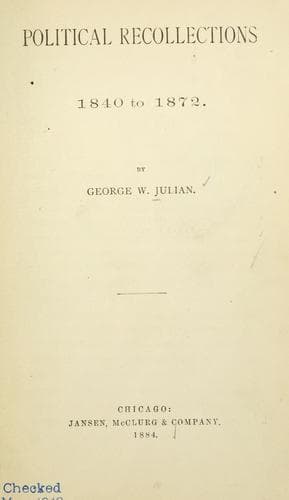
Political Recollections: 1840 to 1872Julian, George Washington
History
Political Recollections: 1840 to 1872
Julian, George Washington
Republican Party (U.S. : 1854- ) -- History; United States -- Politics and government
Democracy into its support could not fail to divide the party, and
at the same time completely unmask the extreme and startling designs
which the slave power had been stealthily maturing. But that power
was now absolutely bent upon its purpose, and morally incapable of
pausing in its work. Its demand was a slave code for the Territories,
and it would accept nothing less. Jefferson Davis was the champion
of this policy, which he embodied in a series of resolutions and
made them the text of an elaborate argument; and Mr. Douglas replied
in a speech which at once vindicated himself and overwhelmingly
condemned the party with which he had so long acted. The resolutions,
however, were adopted by the Senate, which thus proclaimed its
purpose to nationalize slavery.
In the meantime these remarkable legislative proceedings had their
counterpart in increasing lawlessness and violence throughout the
South. This was illustrated in such facts as the expulsion of
members of the Methodist Church North from Texas, the imprisonment
of Rev. Daniel Worth, in North Carolina, for circulating Helper's
"Impending Crisis"; the exile from Kentucky of the Rev. John G.
Fee and his colony of peaceable and law-abiding people, on account
of their anti-slavery opinions; and the espionage of the mails by
every Southern postmaster, who under local laws had the power to
condemn and "burn publicly" whatever he deemed unfit for circulation,
which laws had been pronounced constitutional by Caleb Cushing,
while Attorney General of the United States under Mr. Pierce, and
were "cheerfully acquiesced in" by Judge Holt, Postmaster General
under Buchanan. In Virginia the spirit of lawlessness became such
a rage that one of her leading newspapers offered a reward of fifty
thousand dollars for the head of Wm. H. Seward, while another paper
offered ten thousand dollars for the kidnapping and delivery in
Richmond of Joshua R. Giddings, or five thousand dollars for his
head. In short, the reign of barbarism was at last fully ushered
in, and the whole nation was beginning to realize the truth of Mr.
Lincoln's declaration, which he borrowed from St. Mark, that "a
house divided against itself can not stand." The people of the
free States were at school, with the slaveholders as their masters;
and the dullest scholars were now beginning to get their lessons.
Even the Know-Nothings and Silver-Grey Whigs were coming up to the
anxious seat, under the enlightening influence and saving-grace of
slaveholding madness and crime. The hour was ripe for action, and
the dawn of freedom in the South was seen in the coming emancipation
of the North.
Public-domain text, read in full here on John Shaqi.
Reviews
Reviews
No reviews yet
Be the first to share your thoughts on this work.
Elsewhere in the archive
Join the Discussion
Join the discussion
Sign in to leave a comment or review.
Sign InorCreate an account