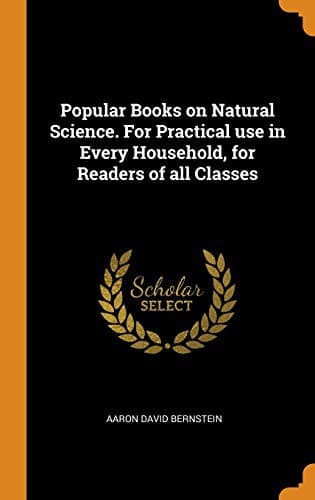
Popular Books on Natural Science: For Practical Use in Every Household, for Readers of All Classes — John Shaqi
Popular Books on Natural Science: For Practical Use in Every Household, for Readers of All ClassesBernstein, Aaron David
Science
Popular Books on Natural Science: For Practical Use in Every Household, for Readers of All Classes
Bernstein, Aaron David
Science -- Popular works
If milk contained no phosphorus, not only would the bones and teeth
suffer from the want of it, but even the completion of the child's brain
could not properly take place, and the child could not replace the
quantity of brain which it emits and loses every moment by breathing.
If there were no iron in the mother's milk, the child would die from the
green-sickness, a malady which, by the way, is dangerous also for grown
people, and which is cured by medicines containing plenty of iron.
If there were no sulphur in it, the child's bile could not develop; the
bile, as every one knows, has an important function in the human body.
These are but accessory elements of the mother's milk, elements which
usually are not looked upon as articles of food; for who is aware that
he must eat, and actually does eat daily, phosphorus, iron, calcareous
earth, and sulphur? And not only these; there are a great many other
articles, such as magnesia, chlorine, and fluor, that we eat without
being aware of it; moreover, our proper food consists also of three
gases: nitrogen, oxygen, and hydrogen; and of a solid substance called
"carbon," which is no less and no more than pure coal.
All these, my friendly readers, are contained in milk--all these are the
elements which in truth constitute the human body. Perhaps some persons
believe that there is nothing easier than to procure proper food. It
would only be necessary to take a certain quantity of carbon, hydrogen,
oxygen, and nitrogen; a little bit of potassium, natron, calcium, and
magnesia; to mix a small piece of iron, sulphur, phosphorus, chlorine,
and fluor, and take this mixture by the spoon at regular intervals, in
order to give the body the necessary aliments. This, however, would be a
mistake, for which the perpetrator would pay with his life.
Although it is true that these substances form the proper and most
important constituents of our daily food; yet, in order to enjoy the
desired result, we must not partake of them in their primary forms; they
can actually feed our body only when they are combined together in a
peculiar, wondrous manner.
In the next chapter it may be seen how nature first must combine these
substances before they are presented to us as proper food; and it will
also be seen, that we receive them sometimes in altogether different
forms and combinations; for example, in the mother's milk, when we eat
the above-named elements in the forms of caseine (cheese), butyrine
(butter), sugar of milk, salt, and water.
These latter names have a more savory sound, have they not?
CHAPTER IV.
HOW NATURE PREPARES OUR FOOD.
Public-domain text, read in full here on John Shaqi.
Reviews
Reviews
No reviews yet
Be the first to share your thoughts on this work.
Join the Discussion
Join the discussion
Sign in to leave a comment or review.
Sign InorCreate an account