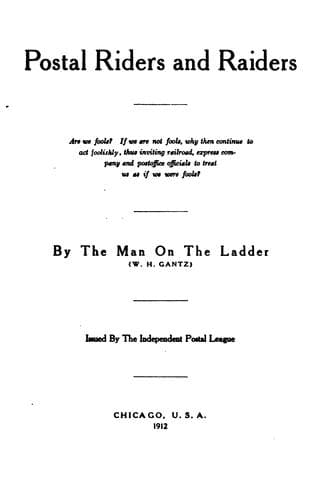
Postal service -- United States -- Second-class matter
“If every fact has been adduced that would lead to a proper conclusion
as to what the pay ought to be, if we are to go again over the same
field of investigation with no possibility of any more light, tell me
what sense there is in expending the public money for that purpose? And,
then the very minute you undertake to reach the correct result you are
confronted with a proposition that you cannot justly charge the cost
of transportation and handling to a class of matter flatly _that in
itself produces a return to the government in another class of matter,
probably in excess of the charges of transportation and handling of that
matter itself_--the second class. How are you to draw the lines for the
determination of these questions? You are in the dark; it is a chaotic
proposition, considering the method by which it must be determined today.”
I take it, that however much they may differ from him in his political
and economic views, readers recognize in William Randolph Hearst one
of the most alert and best informed men in this country on the subject
of publishing and distributing periodical literature. He certainly
ranks among the largest, if he is not indeed the largest, publisher and
distributer of newspapers and other periodical prints there is in this
country,--yes, I may say, in the world.
On February 24, 1911, a letter over Mr. Hearst’s signature appeared
in the Washington Post. In this communication he touches upon the
efficiency--rather the inefficiency--of the Postoffice Department in
handling the postal service of this country. I would like to reproduce
the letter entire, but cannot. I will, however, reprint some of its
cogent statements which bear largely upon the point under consideration.
Mr. Hearst says:
I know something about the cost of distribution of publications.
I know something about the reasons for the excessive cost of
distribution of the postoffice. And I say that the high cost
of distribution in the postoffice is largely due to loose
and careless and reckless methods, to antiquated systems and
incompetent management.
It is estimated that 40 per cent of the charged weight of mail
matter is composed of cumbersome mail bags and their heavy iron
locks and fastenings.
How absurd to imagine that a man who wanted to break into a mail
bag would be deterred by a ponderous lock.
The postoffice department might as well insist that a
burglar-proof lock be affixed to every letter, under the inane
impression that the only way to tear open a letter would be to
pick a lock.
I know, too, personally and positively, of an instance where
the great mass of western mail was sent over one railroad and
when the bulk of it was transferred to another railroad, all the
postal clerks previously employed were maintained on the first
railroad for over two years after the mail had been transferred.
Public-domain text, read in full here on John Shaqi.
Reviews
Reviews
No reviews yet
Be the first to share your thoughts on this work.
Join the Discussion
Join the discussion
Sign in to leave a comment or review.
Sign InorCreate an account