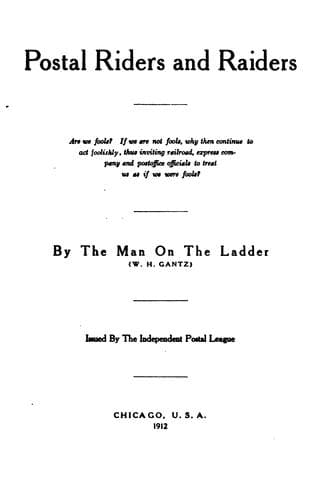
Postal service -- United States -- Second-class matter
But in this year is seen for the first time, in important
proportions, a new item of expense, $4,000,000 for rural free
delivery. Our government had _wisely and beneficently_ extended
the service of the postoffice to farmers in isolated communities,
regardless of the expense of so doing. The report of the
Postmaster General for 1902 says: “It will be seen that had it
not been for the large expenditure on account of rural free
delivery, _the receipts would have exceeded the expenditures by
upward of $1,000,000_.”
It will be clear, from these figures, which are taken from the
reports of the Postmaster General, that beginning with the
advent of the second-class pound-rate system, _the deficit of
the postoffice has steadily declined_, the rate of decrease
being always coincident with the expansion of circulation and
advertising of periodicals, until in 1902 there was a substantial
surplus, which the government _wisely saw fit to use for a
purpose not related to the needs of magazines and periodicals or
to their expansion_.
A REAL SURPLUS OF OVER $74,000,000 IN NINE YEARS.
Since 1902 there has _always been a surplus_ in the operations of
the Postoffice Department, outside of the money the Government
has seen fit to expend for rural free delivery, (wisely, and
otherwise wastefully.) In the present year, 1910, the report of
the Postmaster General shows a _surplus_ of over $23,000,000
outside the loss on the rural free delivery service of
$29,000,000. The years 1902 to 1910 have each shown a surplus
in the postoffice profit and loss account, the nine years
aggregating over $74,000,000, outside the actual loss on the
rural free delivery system.
How enormously second-class mail aids the department’s finances
by originating profitable first-class postage can be appreciated
by referring to the specific examples in Exhibit F.
It should be borne in mind that the turning of large deficits
into actual surpluses, which has come coincidently with the
expansion of second-class mail, of circulation pushing, and
of advertising, has come in _spite of an enormous expansion
in governmental mail, carried free, and Congressional mail,
franked, which has not been credited to the postoffice at all in
calculating the actual surplus shown above_.
Next the publishers come forward with “Exhibit F.” Their “Exhibit F” is
not merely an “exhibit.” It is an _exhibition_, with a three-ring circus,
a menagerie and moving pictures as a “side.” Candidly, I am of the
opinion that it was this “Exhibit F” of the publishers which induced our
friend, the Postmaster General, to loosen the clutch on his mental gear.
Of course, it is possible Mr. Hitchcock did not, nor has not, read this
“F” of the publishers. If such a misfortune has cast its shadow across
his promising career, I regret it.
“Why?”
Public-domain text, read in full here on John Shaqi.
Reviews
Reviews
No reviews yet
Be the first to share your thoughts on this work.
Elsewhere in the archive
Join the Discussion
Join the discussion
Sign in to leave a comment or review.
Sign InorCreate an account