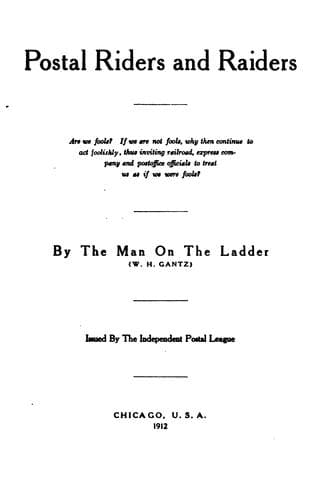
Postal service -- United States -- Second-class matter
Second, There is probably just as high a moral code--just as high a
standard and practice of veracity--among the periodical publishers of
this country as there is among officials of the Federal Postoffice
Department.
I am of opinion that few, indeed, among my readers will be found to
question the fairness of that statement. Especially will they not
question it when they take into consideration the fact _that pages of the
publishers’ testimony were under oath, or jurat_.
CHAPTER VII.
POSTAL REVENUES FROM ADVERTISING.
Now, the Postmaster General’s whole talk--his whole word-splutter--was,
it seems, to create an impression that the government was losing millions
annually _because of the large amount of advertising matter distributed
by magazines and other periodicals_.
On the other hand, the publishers in their “Exhibit F,” and elsewhere,
try to show, and in the writer’s opinion _do_ show quite conclusively
and dependably, that the excess of expenditure over receipts in the
Postoffice Department would be _two to four times greater than it now
is were it not for the first, third and fourth class revenues resulting
directly from those advertising pages in our periodical literature_.
Before giving these publishers a chance to tell the truth, as presented
in their “Exhibit F,” I desire to make a few remarks about the point
under consideration--the profits to the _government from periodical
advertising_.
The publishers present the evidence of their counting-rooms--the _inside_
testimony. I desire to present some outside testimony.
I may present it in an awkward, raw way, but I have a conceit that the
“jury” will give it consideration.
Three months ago, there was a “party at our house.” No, it was not
a bridge party. Mrs. M. On The L. has, in my visual range, I can
here assure you, many commendable virtues--meritorious qualities and
qualifications. Likewise, she has some faults. The latter I cannot, if
the dove of peace is to continue perching on our domicile lodge pole,
mention here. I may, however, say with entire safety, that “bridge” and
alleged similar feminine amusements are not among them.
The party to which I advert was a “tea.” The guests were six,--Mrs. M.
On The L. serving. The guests not only had “the run” of the house, but
they _took possession of it_. I stuck to my “den” until it was invaded
and then--well, then, my dear trousered reader, I did precisely what you
would have done. I backed off--I surrendered.
“What was the result?”
Public-domain text, read in full here on John Shaqi.
Reviews
Reviews
No reviews yet
Be the first to share your thoughts on this work.
Elsewhere in the archive
Join the Discussion
Join the discussion
Sign in to leave a comment or review.
Sign InorCreate an account