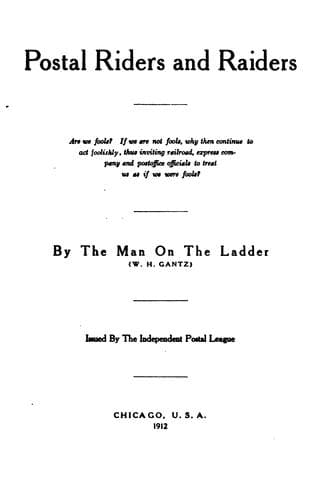
Postal service -- United States -- Second-class matter
In this particular case, the chief feature of the result was that
these seven women, _in less than ten minutes_, had appropriated every
copy of all the latest, and some a month or more old, of the magazines
and weeklies about my work-shop. They also annexed me. I “just had
to go downstairs and have a cup of tea with them.” Although I am not
entrancingly fond of tea, I did exactly what you would have done. I went.
Necessarily, I had to be good. I was good. I said--as near as I knew
how--the things that were proper to say and as near the proper time as I
could. That is, I said little and listened much.
It is of what I heard--and afterward learned--I wish here to speak.
I wish to speak of it because it fits like a glove to the point the
publishers make in their “Exhibit F,” which is to follow.
While the hostess was preparing and spreading luncheon--a necessary
concomitant of all “teas,” other than mentioned in novels--the six guests
scanned the magazines and talked magazines. From their conversation it
appeared that five of the six took, either by subscription or news-stand
purchase, one or two monthly magazines “regularly.” Whether the ladies
_read_ them or not was not made clear to me. One of them did make mention
of two “splendid stories”--“The Ne’er do Well,” by Rex Beach, and, at the
time of the “tea,” appearing, in serial, in one of the monthlies. The
other was a short story entitled “The Quitters,” which, the lady stated,
had appeared in one of the magazines some time previous.
Now, so far as I can recall, the reference made by this one of the six
ladies was the only mention made of the “literary” features of the
magazines they had read or to such features of those they were examining.
There was considerable talk and attention given to the body illustrations.
In calling such stories as the lady mentioned “literary” I presume
apologies are due the Penrose-Overstreet Commission. While both the
stories are “brand-new,” are well written, each teaching a lesson--have,
in short, all the essential elements of “currency and periodicity”--yet
that commission, in the anxious interest it displayed to secure “a
general exclusion act” against fiction in periodicals, would, possibly,
see nothing of literary merit in either of the stories the lady mentioned.
I shall, however, offer no apologies to the commission for classing the
two stories as literature and of exemplary currency. On a previous page I
have given my reasons for differing from the commission on its strictures
on current fiction as run in our standard monthlies and weeklies. The
lady’s expressed opinion of the two stories is another reason for
differing from that expressed by the commission. In my judgment, the lady
who spoke has a broader, juster and far more comprehending knowledge of
literature--of its merits and demerits, whether fiction, historical,
biographical or classic--than has any member of that commission.
Public-domain text, read in full here on John Shaqi.
Reviews
Reviews
No reviews yet
Be the first to share your thoughts on this work.
Elsewhere in the archive
Join the Discussion
Join the discussion
Sign in to leave a comment or review.
Sign InorCreate an account