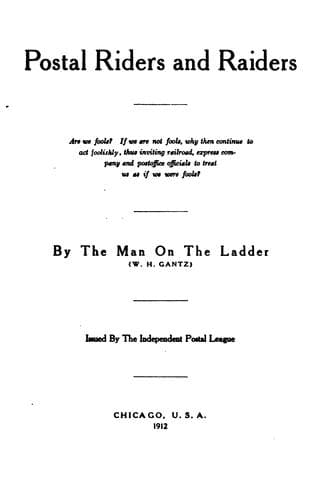
Postal service -- United States -- Second-class matter
Of course, I do not know what the mothers of that son and daughter who
were to be started in preparatory school work did. It is safe to presume
however, that they adopted the plan suggested by Thomas’ mother. We
know what she did. At any rate we have her own statement of the course
she pursued, and there can be advanced no valid reason for doubting her
word. Besides, as she is our “next-door” neighbor, I have made, within
the month, special inquiry of her as to what she did. I found that she
had kept the catalogues of the schools to which she had written and had
carefully “filed” in a _twined package_, as a careful housekeeper usually
files things, every letter she had received from the schools.
More than that: She wrote nine of the schools a second letter and three
of them, she wrote _four times_. To the Wisconsin school to which she
finally intrusted the training and instruction of her son she wrote _six
times_.
Now let us see what revenue the federal postal fund _actually_ received
from this one mother in her efforts to place her boy in a good, safe
school.
First the mother herself wrote forty-five letters. On these the
Postoffice Department collected 90 cents.
Second, her “twine file” shows that, all told, she had received from
the twenty-two schools written to, a total of 163 letters. On these the
government collected $3.26.
Third, the catalogues sent her were of various sizes. Their carriage
charge, at third-class rates, I think would range from two to six cents
or more. Putting the average at only three cents, which in my judgment is
low, the government collected for their carriage 66 cents.
Fourth, thirteen of the schools, either not knowing her boy had been
matriculated or thinking she might have other boys “comin’ on” to
preparatory school age, sent her their catalogues for the following
year--another 39 cents.
Add those four items and you will readily ascertain that the government
received $5.21 in revenue from the efforts of Thomas’ mother to select
a school for him--a school that would give him military training and
discipline, as well as academic instruction in selected studies.
_Her course of action was prompted entirely by the school advertisements
she saw in two magazines._
How many other mothers and fathers were influenced to similar action by
the three or four school “ad” pages in those two magazines I do not know.
There must, however, have been many, I take it, otherwise the schools and
preparatory colleges would not persist in advertising so extensively,
year after year, during the summer months, in our high-class monthly and
weekly periodicals.
Public-domain text, read in full here on John Shaqi.
Reviews
Reviews
No reviews yet
Be the first to share your thoughts on this work.
Elsewhere in the archive
Join the Discussion
Join the discussion
Sign in to leave a comment or review.
Sign InorCreate an account