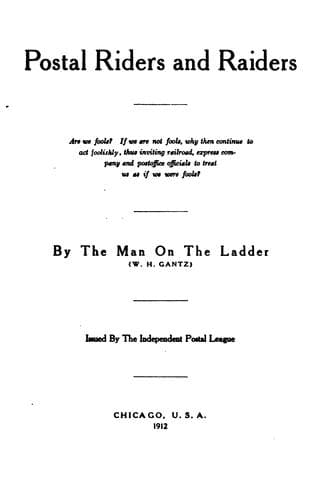
Postal service -- United States -- Second-class matter
The two magazines from which Thomas’ mother got her school address
weighed a little under a pound each. If they reached her by mail, the
government got only about two cents for their carriage and delivery,
which was ample pay--$20.00 a ton--for the service. But supposing Mr.
Hitchcock’s wild figures were correct--that it cost the government 18
cents to deliver those two magazines to that mother--a rate of $180.00
per ton. Of course, no man could so suppose unless he stood on his head
in one corner of a room and figured results as the square of the distance
at which things appeared to him, or chanced to be one of those “blessed”
mortals prenatally endowed with what may be called mental strabismus.
But for the sake of the argument, let us suppose that it did cost the
government 18 cents to deliver those two magazines to Thomas’ mother; let
us admit that that falsehood is fact, that that foolishness is sense.
Then what?
A magazine weighing one pound and printed on the grade of paper used by
our high-class periodicals will count 250 or more pages. Four pages of
school “ads,” therefore, would count for about _one-fourth of one ounce_.
Even at Mr. Hitchcock’s absurd figure of nine cents a pound, the cost
to the government of carrying those four pages of school advertisements
in each of two monthly magazines to the mother of Thomas _was less than
four-fifths of one cent_.
Do you grasp the point?
Remember, Mr. Hitchcock has separated himself from much talk to show to
a doubting public that it is _the advertising pages of periodicals which
over-burden the postal service and are responsible, largely, for the
alleged “deficit.”_
I say “alleged” deficit. I say so, because it is not, and never was, a
deficit _de facto_. I shall later give my reasons for so saying--shall
show that this much talked of deficit in the Postoffice Department’s
revenues is _quasi_ only--a mere matter of accounting, and bad accounting
at that.
But here we are considering the cost to the government of carrying and
delivering _advertising pages_ to the reading public of this Nation.
Especially are we considering the transaction between the government and
the mother of Thomas--a transaction induced and promoted by eight pages
of advertising--four pages in each of two magazines.
As just stated, it cost the government _less than four-fifths of one
cent_, even if we rate the carriage and delivery cost at Postmaster
General Hitchcock’s absurd figure of nine cents a pound, to deliver those
eight pages of school advertisement to Thomas’ mother. Even the delivery
of the _complete_ magazines which printed those advertising pages would,
at Mr. Hitchcock’s own figures, cost the government only about 18 cents.
Let’s admit it all--the worst of it, and the worst possible construction
that the worst will stand. Then how does the government stand in relation
to the resultant transaction--_the transaction induced by those eight
pages of advertising_?
Public-domain text, read in full here on John Shaqi.
Reviews
Reviews
No reviews yet
Be the first to share your thoughts on this work.
Elsewhere in the archive
Join the Discussion
Join the discussion
Sign in to leave a comment or review.
Sign InorCreate an account