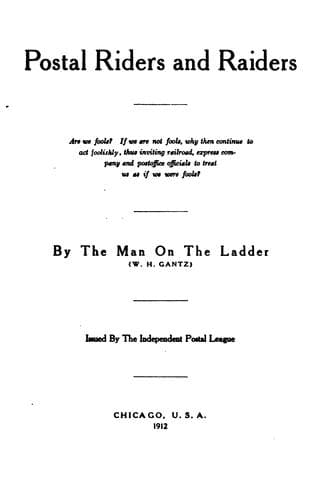
Postal service -- United States -- Second-class matter
As has previously been stated, and I believe well sustained by the
facts, no business, however well established, can stand an increase of
300 per cent in the haulage and delivery cost of its output without
sustaining great financial loss. The fair-minded reader will, I believe,
agree that the publishers in presenting their case to Mr. Hitchcock, to
the Penrose-Overstreet and other commissions, proved the truth of that
statement quite conclusively.
Well, if that be true, legislation of the sort proposed in the Hitchcock
“rider” must necessarily, after adjudication, put all the lesser weeklies
and monthlies (those not financially strong) out of business. Likewise
hundreds of the smaller newspapers must discontinue issue. Of course,
Mr. Hitchcock prattled about the newspapers not being affected by his
proposed amendment. But, as previously stated, no court of justice in
this country would sustain such a biased, prejudiced piece of class
legislation as that proposed in the “rider.”
CHAPTER VIII.
WHO ARE AFFECTED.
Let us see who really would be affected.
As just cited there necessarily would be thousands of periodical
publishers affected--virtually ruined. But, let us go down to things
elemental in this question--_down to the stumpage_.
The great educational white way of our periodical literature is builded
upon _wood pulp_.
In an opening paragraph of this volume I adverted to that fact. The chief
pulp woods are spruce of the North--even of the distant North--and the
Northwest. Then come cottonwood, basswood and soft maple, of the South,
Southeast and New England. Of course, there are several other kinds of
pulpwoods, but they are not used extensively for the manufacture of
white paper, unless chemically treated, and such treatment makes them
expensive. Of the pulpwoods I have named, spruce is far and away the most
extensively used. From spruce is produced the best pulp. In “milling,” it
shows body, fiber, strength--it gives toughness to the milled sheet or
the Web roll.
But that is enough. I am not an expert in pulp-wood stocks. The point I
am trying to call to the reader’s attention is that _any legislation_
which cuts down the consumption of wood pulp must necessarily “affect”
some other folks besides “a few magazine publishers.”
First, a just adjudication of such a piece of legislation as that
proposed in Mr. Hitchcock’s rider amendment would put from thirty to
fifty per cent of our weaker (but excellent) periodicals on the financial
rocks--put them out of business. They consume thousands of tons yearly of
pulp-wood paper.
It will, I think, be freely admitted that such periodicals would be out
of--_forced out of_--the pulp-wood market--I mean out of the wood-pulp
paper market, which amounts to the same thing.
Public-domain text, read in full here on John Shaqi.
Reviews
Reviews
No reviews yet
Be the first to share your thoughts on this work.
Elsewhere in the archive
Join the Discussion
Join the discussion
Sign in to leave a comment or review.
Sign InorCreate an account